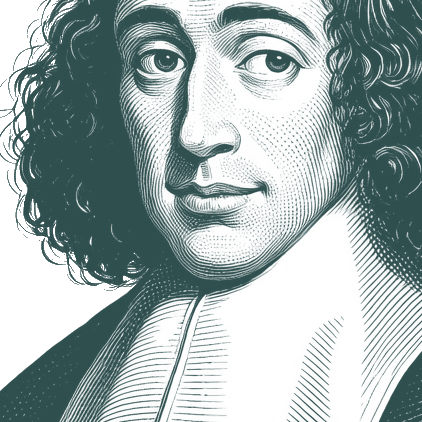
Spinoza died on the 21st of February, 1677, in the forty-fourth year of his age. The cause of his death was consumption, from which he had long been … - Benedictus de Spinoza
""
Spinoza died on the 21st of February, 1677, in the forty-fourth year of his age. The cause of his death was consumption, from which he had long been a sufferer; this was in harmony with his system of philosophy, according to which all particularity and individuality pass away in the one substance. A Protestant divine, Colerus by name, who published a biography of Spinoza, inveighs strongly against him, it is true, but gives nevertheless a most minute and kindly description of his circumstances and surroundings — telling how he left only about two hundred thalers, what debts he had, and so on. A bill included in the inventory, in which the barber requests payment due him by M. Spinoza of blessed memory, scandalizes the parson very much, and regarding it he makes the observation: “Had the barber but known what sort of a creature Spinoza was, he certainly would not have spoken of his blessed memory.” The German translator of this biography writes under the portrait of Spinoza: characterem reprobationis in vultu gerens, applying this description to a countenance which doubtless expresses the melancholy of a profound thinker, but is otherwise wild and benevolent. The reprobatio is certainly correct; but it is not a reprobation in the passive sense; it is an active disapprobation on Spinoza's part of the opinions, errors and thoughtless passions of mankind.
Benedictus de Spinoza (24 November 1632 – 21 February 1677) was a social and metaphysical philosopher known for the elaborate development of his monist philosophy, which has become known as Spinozism. Controversy regarding his ideas led to his excommunication from the Jewish community of his native Amsterdam. He was named Baruch ("blessed" in Hebrew) Spinoza by his synagogue elders and known as Bento de Spinoza or Bento d'Espiñoza, but afterwards used the name Benedictus ("blessed" in Latin) de Spinoza.
Native Name:
בָּרוּךְ שְׂפִּינוֹזָה
•
Benedito de Espinosa
Alternative Names:
Benedict de Spinoza
•
Baruch de Espinosa
•
Barukh Shpinozah
•
Benoît de Spinoza
•
Sbīnūzā
•
Ispīnūzā
•
Barukh Spinoza
•
Bento de Espinosa
•
Baruch d' Espinoza
•
Shpinozah
•
Baruch de Spinoza
•
Spinoza
•
Benoit de Spinoza
•
Benedictus De Spinoza
•
Benedictus Spinoza
•
Baruch Spinoza
•
Baruch Benedictus de Spinoza
[...] In this Spartan room there was a man pacing little steps, his hands clasped behind his back, his big head thrust forward as though to butt. The man looked exactly like Ben-Gurion, but there was no way he could actually be Ben-Gurion. Every child in Israel, even in kindergarten, in those days knew in his sleep what Ben-Gurion looked like. But since there was no television yet, it was obvious to me that the Father of the Nation was a giant whose head reached the clouds, whereas this impostor was a short, tubby man whose height was less than five foot three. (...) David Ben-Gurion was about seventy-five at the time, and I was barely twenty. (...) I sat down in a flash on the chair facing the desk. I sat bolt upright, but only on the edge of the chair. There was no question of leaning back. Silence. The Father of the Nation continued to pace to and fro with hasty little steps, like a caged lion or someone who was determined not to be late. After half an eternity, he suddenly said: “Spinoza!” And he stopped. When he had walked away as far as the window, he whirled around and said: “Have you read Spinoza? You have. But maybe you didn't understand? Few people understand Spinoza. Very few.” And then, still pacing to and fro, to and fro, between the window and the door, he burst into a protracted dawn lecture on Spinoza's thought. (...) But Ben-Gurion, it turned out, was enjoying lecturing on Spinoza before seven o'clock in the morning. And he did indeed continue for a few minutes without interruption.
it is certain that seditions, wars, and contempt or breach of the laws are not so much to be imputed to the wickedness of the subjects, as to the bad state of the dominion.
Unlimited Quote Collections
Organize your favorite quotes without limits. Create themed collections for every occasion with Premium.
El honor, en fin, constituye un gran impedimento porque para lograrlo es preciso vivir según la manera de ver de la gente, es decir, huir de lo que ella huye y buscar lo que ella busca.