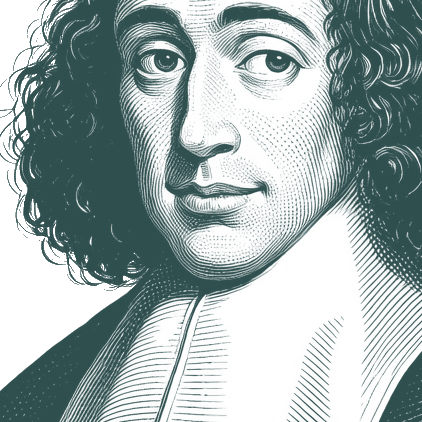
Benedictus de Spinoza (24 November 1632 – 21 February 1677) was a social and metaphysical philosopher known for the elaborate development of his monist philosophy, which has become known as Spinozism. Controversy regarding his ideas led to his excommunication from the Jewish community of his native Amsterdam. He was named Baruch ("blessed" in Hebrew) Spinoza by his synagogue elders and known as Bento de Spinoza or Bento d'Espiñoza, but afterwards used the name Benedictus ("blessed" in Latin) de Spinoza.
Native Name:
בָּרוּךְ שְׂפִּינוֹזָה
•
Benedito de Espinosa
Alternative Names:
Benedict de Spinoza
•
Baruch de Espinosa
•
Barukh Shpinozah
•
Benoît de Spinoza
•
Sbīnūzā
•
Ispīnūzā
•
Barukh Spinoza
•
Bento de Espinosa
•
Baruch d' Espinoza
•
Shpinozah
•
Baruch de Spinoza
•
Spinoza
•
Benoit de Spinoza
•
Benedictus De Spinoza
•
Benedictus Spinoza
•
Baruch Spinoza
•
Baruch Benedictus de Spinoza
Beauty, my dear Sir, is not so much a quality of the object beheld, as an effect in him who beholds it. If our sight were longer or shorter, or if our constitution were different, what now appears beautiful to us would seem misshapen, and what we now think misshapen we should regard as beautiful. The most beautiful hand seen through the microscope will appear horrible. Some things are beautiful at a distance, but ugly near; thus things regarded in themselves, and in relation to God, are neither ugly nor beautiful. Therefore, he who says that God has created the world, so that it might be beautiful, is bound to adopt one of the two alternatives, either that God created the world for the sake of men's pleasure and eyesight, or else that He created men's pleasure and eyesight for the sake of the world. Now, whether we adopt the former or the latter of these views, how God could have furthered His object by the creation of ghosts, I cannot see. Perfection and imperfection are names which do not differ much from the names beauty and ugliness.
I believe we can guess at the first time Einstein read Baruch Spinoza's Ethics (Ethica Ordinae Geometrico Demonstrata), a system constructed on the Euclidean model of deductions from propositions. Soon after getting his first real job at the patent office, Einstein joined with two friends to form a discussion circle, meeting once or twice a week in what they called, with gallows humor, the Akademie Olympia. We know the list of books they read and discussed. High among them, reportedly at Einstein's suggestion, was Spinoza's Ethics, which he read afterwards several times more. Even when his sister Maja joined him in Princeton in later life and was confined to bed by an illness, he thought that reading a good book to her would help, and chose Spinoza's Ethics for that purpose. By that time Spinoza's work and life had long been important to Einstein. He had written an introduction to a biography of Spinoza (by his son-in-law, Rudolf Kayser, 1946); he had contributed to the Spinoza Dictionary (1951); he had referred to Spinoza in many of his letters; and he even had composed a poem in Spinoza's honor. He admired Spinoza for his independence of mind, his deterministic philosophical outlook, his skepticism about organized religion and orthodoxy – which had resulted in his excommunication from his synagogue in 1656 – and even for his ascetic preference, which compelled him to remain in poverty and solitude to live in a sort of spiritual ecstasy, instead of accepting a professorship at the University of Heidelberg.
Enhance Your Quote Experience
Enjoy ad-free browsing, unlimited collections, and advanced search features with Premium.
El eje de la relación entre el Estado y los ciudadanos (que no sólo súbditos) es el consenso o «común acuerdo» en el que descansa el contrato de convivencia y gobierno, el cual debe cumplirse y revalidarse cotidianamente por ambas partes (que lo son de un mismo todo).