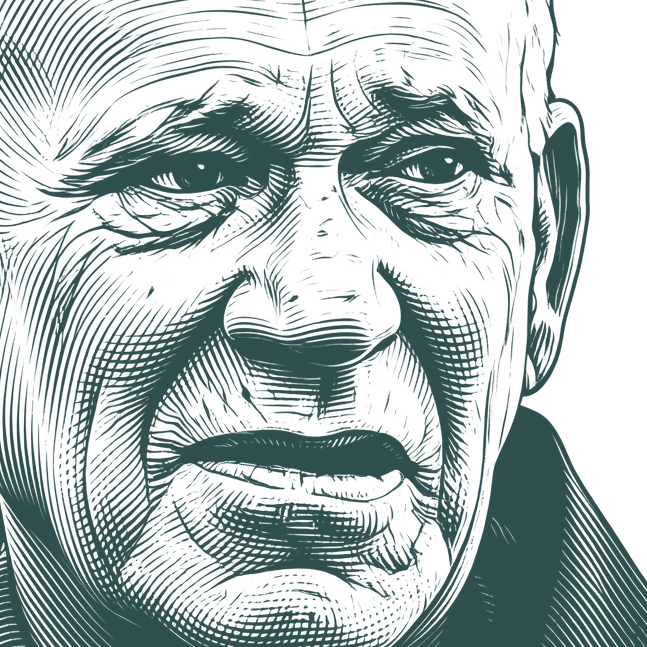
It is precisely because we can never really know ourselves, but only guess, that we are so vehement about the good and the evil ascribed to us by oth… - Eric Hoffer
""
It is precisely because we can never really know ourselves, but only guess, that we are so vehement about the good and the evil ascribed to us by others. In maintaining ourselves against all comers, we are maintaining something that is unknown, uncertain, and never wholly provable. We need a chorus of consent, and we are engaged in an unceasing proselytizing campaign in our own behalf.
Eric Hoffer (25 July 1902 – 21 May 1983) was an American writer on social and political philosophy. His first book, The True Believer: Thoughts On The Nature Of Mass Movements (1951) is widely recognized as a classic on mass-movements and the psychological roots of fanaticism. Despite rising to fame with the success and popularity of his writings, he continued to work as a longshoreman until retiring at age 65.
Biography information from
Wikiquote·
Portrait adapted from
Wikimedia Commons, White House of the President of the United States; uploaded to YouTube by TheLBJLibrary (Public domain / CC0)
Portrait from Wikimedia Commons. Credit: White House of the President of the United States; uploaded to YouTube by TheLBJLibrary. Used under Public domain / CC0. Processed and styled by Quotewise.
Go Premium
Support Quotewise while enjoying an ad-free experience and premium features.
To the excessively fearful the chief characteristic of power is its arbitrariness. Man had to gain enormously in confidence before he could conceive an all-powerful God who obeys his own laws.
We have to adjust ourselves, and every radical adjustment is a crisis in self-esteem: we undergo a test, we have to prove ourselves.
Works in ChatGPT, Claude, or Any AI
Add semantic quote search to your AI assistant via MCP. One command setup.
The opposite of the religious fanatic is not the fanatical atheist but the gentle cynic who cares not whether there is a God or not. The atheist is a religious person. He believes in atheism as though it were a new religion.