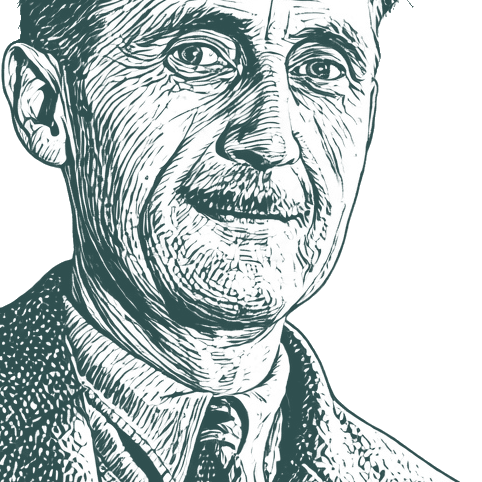
Out of this concourse of several hundred people, perhaps half of whom were directly connected with the writing trade, there was not a single one who … - George Orwell
""
Out of this concourse of several hundred people, perhaps half of whom were directly connected with the writing trade, there was not a single one who could point out that freedom of the press, if it means anything at all, means the freedom to criticise and oppose.
George Orwell (25 June 1903 – 21 January 1950) was the pen name of British novelist, essayist, and journalist Eric Arthur Blair, whose work is characterised by lucid prose, awareness of social injustice, opposition to totalitarianism, and strong support of democratic socialism.
Biography information from
Wikiquote·
Portrait adapted from
Wikimedia Commons, Cassowary Colorizations (CC BY)
Also Known As
Pen Names:
John Freeman
Birth Name:
Eric Arthur Blair
Alternative Names:
Orwell
•
Eric Blair
•
P. S. Burton
Shakespeare starts by assuming that to make yourself powerless is to invite an attack. This does not mean that everyone will turn against you (Kent and the Fool stand by Lear from first to last), but in all probability someone will. If you throw away your weapons, some less scrupulous person will pick them up. If you turn the other cheek, you will get a harder blow on it than you got on the first one. This does not always happen, but it is to be expected, and you ought not to complain if it does happen. The second blow is, so to speak, part of the act of turning the other cheek. First of all, therefore, there is the vulgar, common-sense moral drawn by the Fool: "Don't relinquish power, don't give away your lands." But there is also another moral. Shakespeare never utters it in so many words, and it does not very much matter whether he was fully aware of it. It is contained in the story, which, after all, he made up, or altered to suit his purposes. It is: "Give away your lands if you want to, but don't expect to gain happiness by doing so. Probably you won't gain happiness. If you live for others, you must live for others, and not as a roundabout way of getting an advantage for yourself."
Perhaps a man really dies when his brain stops, when he loses the power to take in a new idea.
The past is a curious thing. It's with you all the time. I suppose an hour never passes without your thinking of things that happened ten or twenty years ago, and yet most of the time it's got no reality, it's just a set of facts that you've learned, like a lot of stuff in a history book. Then some chance sight or sound or smell, especially smell, sets you going, and the past doesn't merely come back to you, you're actually in the past.