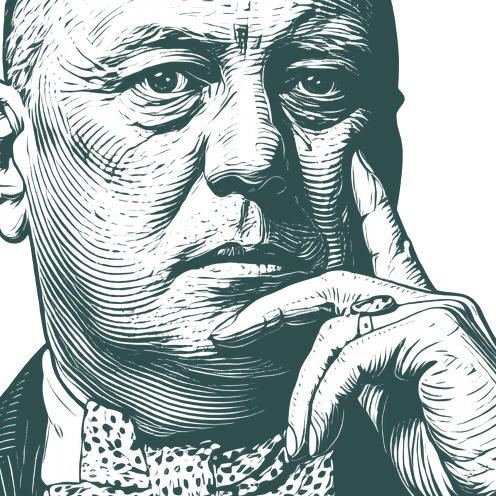
This book is for ALL: for every man, woman, and child. My former work has been misunderstood, and its scope limited, by my use of technical terms. It… - Aleister Crowley
""
This book is for ALL: for every man, woman, and child. My former work has been misunderstood, and its scope limited, by my use of technical terms. It has attracted only too many dilettanti and eccentrics, weaklings seeking in "Magic" an escape from reality. I myself was first consciously drawn to the subject in this way. And it has repelled only too many scientific and practical minds, such as I most designed to influence. But MAGICK is for ALL.
English
Collect this quote
About
Aleister Crowley
Aleister Crowley (12 October 1875 – 1 December 1947), born Edward Alexander Crowley, was a British occultist, mystic, poet, and social provocateur, famous for his development of the philosophical system called Thelema, and his concepts of magic, which he called Magick.
Biography information from
Wikiquote·
Portrait adapted from
Wikimedia Commons, Aleister Crowley (Public domain / CC0)
Also Known As
Pen Names:
H. D. Carr
Also Known As:the Beast 666•Master Therion
Alternative Names:
Edward Alexander Crowley
•
H.D. Carr
•
Therion
The Victrola, the Movies, a lecture: such are the three American alternatives to Silence, Scandal and Squabble. Or else, get drunk. America knows no other devices to enable its inhabitants to endure either their own company or that of their fellow-creatures.
The old spelling MAGICK has been adopted throughout in order to distinguish the Science of the Magi from all its counterfeits.
Go Premium
Support Quotewise while enjoying an ad-free experience and premium features.
"My friend tells me that memory fails me in part because nature mercifully wishes to hide from us things which are painful. The spider-web of protective forgetfulness is woven over the mouth of the cave which conceals the raw head and bloody bones of our misfortunes.
"But the greatest men," says King Lamus, "are those that refuse to be treated like squalling children, who insist on facing reality in every form, and tear off ruthlessly the bandages from their own wounds.