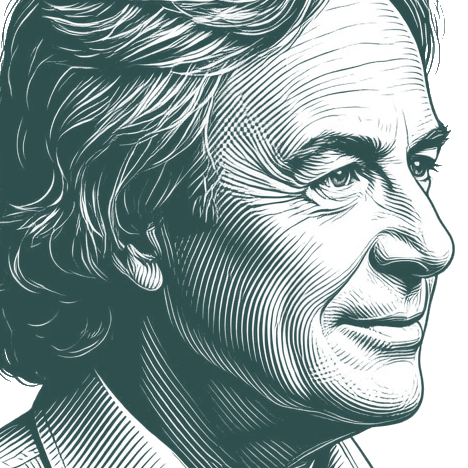
there is a physical problem that is common to many fields, that is very old, and that has not been solved. It is not the problem of finding new funda… - Richard Feynman
""
there is a physical problem that is common to many fields, that is very old, and that has not been solved. It is not the problem of finding new fundamental particles, but something left over from a long time ago — over a hundred years. Nobody in physics has really been able to analyze it mathematically satisfactorily in spite of its importance to the sister sciences. It is the analysis of circulating or turbulent fluids.
Richard Phillips Feynman (May 11, 1918 – February 15, 1988) was an American theoretical physicist. He is known for the work he did in the path integral formulation of quantum mechanics, the theory of quantum electrodynamics, the physics of the superfluidity of supercooled liquid helium, and in particle physics, for which he proposed the parton model. For his contributions to the development of quantum electrodynamics, Feynman received the Nobel Prize in Physics in 1965 jointly with Julian Schwinger and Shin'ichirō Tomonaga. Feynman developed a widely used pictorial representation scheme for the mathematical expressions describing the behavior of subatomic particles, which later became known as Feynman diagrams. During his lifetime, Feynman became one of the best-known scientists in the world.
Biography information from
Wikiquote·
Portrait adapted from
Wikimedia Commons, Copyright Tamiko Thiel 1984 (CC BY-SA)
Also Known As
Pen Names:
Ofey
Native Name:
Richard Phillips Feynman
Alternative Names:
Feynman
•
Dick Feynman
•
Richard P. Feynman
Tell your son to stop trying to fill your head with science — for to fill your heart with love is enough!
In physics the truth is rarely perfectly clear, and that is certainly universally the case in human affairs. Hence, what is not surrounded by uncertainty cannot be the truth.
Go Premium
Support Quotewise while enjoying an ad-free experience and premium features.
It was such a shock to me to see that a committee of men could present a whole lot of ideas, each one thinking of a new facet, while remembering what the other fella said, so that, at the end, the decision is made as to which idea was the best — summing it all up — without having to say it three times. These were very great men indeed.