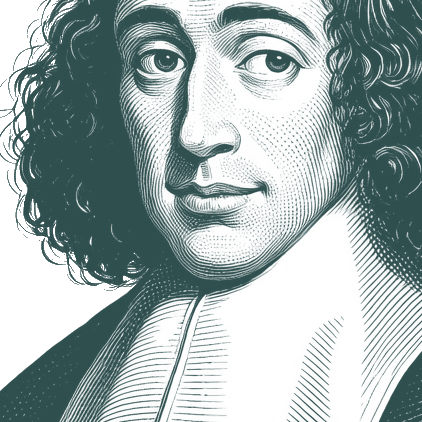
No burlarse, no lamentarse, no detestar, sino comprender - Benedictus de Spinoza
""
No burlarse, no lamentarse, no detestar, sino comprender
Spanish
Collect this quote
About
Benedictus de Spinoza
Benedictus de Spinoza (24 November 1632 – 21 February 1677) was a social and metaphysical philosopher known for the elaborate development of his monist philosophy, which has become known as Spinozism. Controversy regarding his ideas led to his excommunication from the Jewish community of his native Amsterdam. He was named Baruch ("blessed" in Hebrew) Spinoza by his synagogue elders and known as Bento de Spinoza or Bento d'Espiñoza, but afterwards used the name Benedictus ("blessed" in Latin) de Spinoza.
Native Name:
בָּרוּךְ שְׂפִּינוֹזָה
•
Benedito de Espinosa
Alternative Names:
Benedict de Spinoza
•
Baruch de Espinosa
•
Barukh Shpinozah
•
Benoît de Spinoza
•
Sbīnūzā
•
Ispīnūzā
•
Barukh Spinoza
•
Bento de Espinosa
•
Baruch d' Espinoza
•
Shpinozah
•
Baruch de Spinoza
•
Spinoza
•
Benoit de Spinoza
•
Benedictus De Spinoza
•
Benedictus Spinoza
•
Baruch Spinoza
•
Baruch Benedictus de Spinoza
Spinoza accomplishes the synthesis of traditional philosophical components by means of breaking and shattering. It is useless to pursue the presuppositions of Spinozian philosophy if we do not look for them in the qualitative leap determined by his philosophy. The continuity of Spinozian thought with respect to the preceding course of the history of metaphysics consists of a radical discontinuity, one that exalts the utopia of consciousness and freedom (a patrimony of Western thought) in a project of liberation. The perspective of the world is not a utopia, the immanentism is not aesthetic, and the liberation is no longer artisanal, but all of this is presupposed, it is taken as a basis.
An immense role in the development of logic, and in preparing the ground for modern views on its subject matter, a role far from fully appreciated, was played by Spinoza. Like Leibniz, Spinoza rose high above the mechanistic limitations of the natural science of his time. Any tendency directly to universalise partial forms and methods of thinking only useful within the bounds of mechanistic, mathematical natural science was also foreign to him. Insofar as logic was preserved alongside the doctrine of substance, Spinoza treated it as an applied discipline by analogy with medicine, since its concern proved not to be the invention of artificial rules but the co-ordination of human intellect with the laws of thought understood as an ‘attribute’ of the natural whole, only as ‘modes of expression’ of the universal order and connection of things. He also tried to work out logical problems on the basis of this conception. Spinoza understood thought much more profoundly and, in essence, dialectically, which is why his figure presents special interest in the history of dialectics; he was probably the only one of the great thinkers of the pre-Marxian era who knew how to unite brilliant models of acutely dialectical thought with a consistently held materialist principle (rigorously applied throughout his system) of understanding thought and its relations to the external world lying in the space outside the human head. The influence of Spinoza's ideas on the subsequent development of dialectical thought can hardly be exaggerated. ‘It is therefore worthy of note that thought must begin by placing itself at the standpoint of Spinozism; to be a follower of Spinoza is the essential commencement of all Philosophy.’ [Lectures on the History of Philosophy, Hegel]
Unlimited Quote Collections
Organize your favorite quotes without limits. Create themed collections for every occasion with Premium.
Johann Wolfgang von Goethe, in a conversation with Sulpiz Boisserée, 3 August 1815. As quoted in Julie D. Prandi's “Dare To Be Happy!”: A Study of Goethe's Ethics (Lanham, MD: University Press of America, 1993)