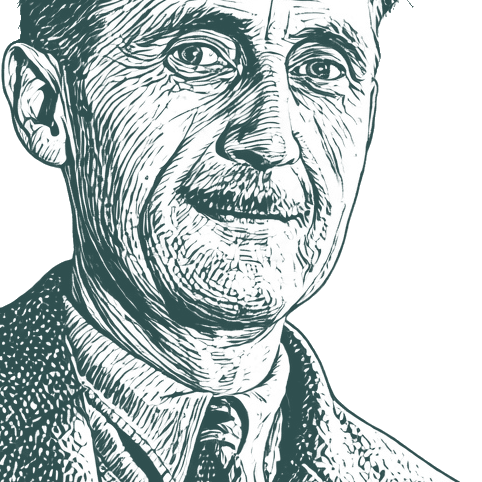
The past is a curious thing. It’s with you all the time. I suppose an hour never passes without your thinking of things that happened ten or twenty y… - George Orwell
""
The past is a curious thing. It’s with you all the time. I suppose an hour never passes without your thinking of things that happened ten or twenty years ago, and yet most of the time it’s got no reality, it’s just a set of facts that you’ve learned, like a lot of stuff in a history book. Then some chance sight or sound or smell, especially smell, sets you going, and the past doesn’t merely come back to you, you’re actually IN the past. It was like that at this moment.
George Orwell (25 June 1903 – 21 January 1950) was the pen name of British novelist, essayist, and journalist Eric Arthur Blair, whose work is characterised by lucid prose, awareness of social injustice, opposition to totalitarianism, and strong support of democratic socialism.
Biography information from
Wikiquote·
Portrait adapted from
Wikimedia Commons, Cassowary Colorizations (CC BY)
Also Known As
Pen Names:
John Freeman
Birth Name:
Eric Arthur Blair
Alternative Names:
Orwell
•
Eric Blair
•
P. S. Burton
[Hitler] has grasped the falsity of the hedonistic attitude to life. Nearly all western thought since the last war, certainly all “progressive” thought, has assumed tacitly that human beings desire nothing beyond ease, security, and avoidance of pain. In such a view of life there is no room, for instance, for patriotism and the military virtues. Hitler, because in his own joyless mind he feels it with exceptional strength, knows that human beings don’t only want comfort, safety, short working-hours, hygiene, birth-control and, in general, common sense; they also, at least intermittently, want struggle and self-sacrifice, not to mention drums, flag and loyalty-parades ... Whereas Socialism, and even capitalism in a grudging way, have said to people “I offer you a good time,” Hitler has said to them “I offer you struggle, danger and death,” and as a result a whole nation flings itself at his feet
In past ages, a war, almost by definition, was something that sooner or later came to an end, usually in unmistakable victory or defeat. In the past, also, war was one of the main instruments by which human societies were kept in touch with physical reality. All rulers in all ages have tried to impose a false view of the world upon their followers, but they could not afford to encourage any illusion that tended to impair military efficiency. So long as defeat meant the loss of independence, or some other result generally held to be undesirable, the precautions against defeat had to be serious. Physical facts could not be ignored. In philosophy, or religion, or ethics, or politics, two and two might make five, but when one was designing a gun or an aeroplane they had to make four. Inefficient nations were always conquered sooner or later, and the struggle for efficiency was inimical to illusions. Moreover, to be efficient it was necessary to be able to learn from the past, which meant having a fairly accurate idea of what had happened in the past. Newspapers and history books were, of course, always coloured and biased, but falsification of the kind that is practiced today would have been impossible. War was a sure safeguard of sanity, and so far as the ruling classes were concerned it was probably the most important of all safeguards. While wars could be won or lost, no ruling class could be completely irresponsible.