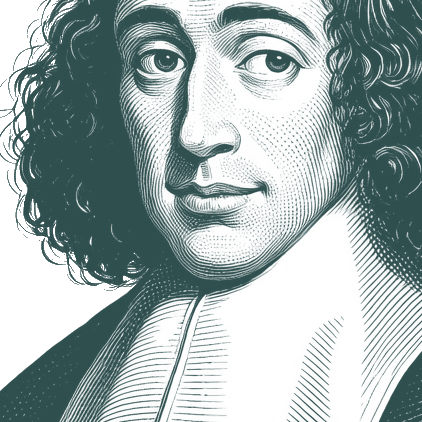
Jacobi, a mystical metaphysician deeply influenced by Hamann, cannot reconcile the demands of the soul and the intellect: 'The light is in my heart: … - Benedictus de Spinoza
""
Jacobi, a mystical metaphysician deeply influenced by Hamann, cannot reconcile the demands of the soul and the intellect: 'The light is in my heart: as soon as I try to carry it to my intellect, it goes out.' Spinoza was for him the greatest master since Plato of the rational vision of the universe; but for Jacobi this is death in life: it does not answer the burning questions of the soul whose homelessness in the chilly world of the intellect only self-surrender to faith in a transcendent God will remedy.
English
Collect this quote
About
Benedictus de Spinoza
Benedictus de Spinoza (24 November 1632 – 21 February 1677) was a social and metaphysical philosopher known for the elaborate development of his monist philosophy, which has become known as Spinozism. Controversy regarding his ideas led to his excommunication from the Jewish community of his native Amsterdam. He was named Baruch ("blessed" in Hebrew) Spinoza by his synagogue elders and known as Bento de Spinoza or Bento d'Espiñoza, but afterwards used the name Benedictus ("blessed" in Latin) de Spinoza.
Native Name:
בָּרוּךְ שְׂפִּינוֹזָה
•
Benedito de Espinosa
Alternative Names:
Benedict de Spinoza
•
Baruch de Espinosa
•
Barukh Shpinozah
•
Benoît de Spinoza
•
Sbīnūzā
•
Ispīnūzā
•
Barukh Spinoza
•
Bento de Espinosa
•
Baruch d' Espinoza
•
Shpinozah
•
Baruch de Spinoza
•
Spinoza
•
Benoit de Spinoza
•
Benedictus De Spinoza
•
Benedictus Spinoza
•
Baruch Spinoza
•
Baruch Benedictus de Spinoza
In the state of nature, wrong-doing is impossible ; or, if anyone does wrong, it is to himself, not to another. For no one by the law of nature is bound to please another, unless he chooses, nor to hold anything to be good or evil, but what he himself, according to his own temperament, pronounces to be so ; and, to speak generally, nothing is forbidden by the law of nature, except what is beyond everyone's power.
I saw that all the things I feared and which feared me had nothing good or bad in them save in so far as the mind was affected by them.
Works in ChatGPT, Claude, or Any AI
Add semantic quote search to your AI assistant via MCP. One command setup.
...[T]he once-accepted assumption that Spinoza was considered a “dead dog” in Kant's day [i.e. before the break of the Pantheismusstreit] is no longer tenable. [...] Suffice it here to recall the well-known fact that Spinoza is the subject of the single longest entry in Bayle's Dictionnaire (1702). It is true that Bayle attempts to refute Spinoza (though some have doubted the sincerity of his intentions) but unlikely that so much space would be dedicated to refuting a neglected philosopher—unlikely, indeed, that Spinoza's relevance would wane once this high-profile entry had been published about him. J. Zedler's Grosses Universal Lexikon (1731–54) gives a similar impression, devoting to Spinoza a five-page discussion. Descartes, by comparison, is discussed in one page. Hume, Locke, Hobbes, and Plato are equally dealt with in one page (or less) each. D. Diderot and J. d'Alembert's Encyclopédie (1751–72) similarly dedicates to Spinoza five times more space than to most relevant thinkers in the history of philosophy. While speaking of Spinoza's metaphysics in extremely hostile terms, the Encyclopédie gives a reliable account of the Ethics definitions and axioms and discusses at length its most important demonstrations, especially E1p1–11. The Dictionnaire, the Lexikon, and the Encyclopédie were the main transmitters of Enlightenment thought. The attention they devoted to Spinoza ensured him a place at the heart of Enlightenment debate. It would be impossible for any educated reader to avoid contact with Spinoza's ideas. It would be easy for every metaphysician to get a grasp on the system of the Ethics. And it would be tempting, for every philosophically inclined thinker, to read Spinoza for themselves.