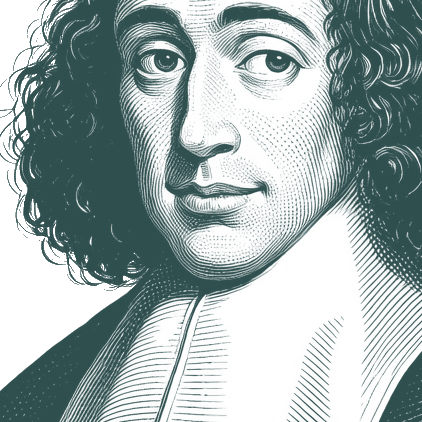
I have striven not to laugh at human actions, not to weep at them, nor to hate them, but to understand them. - Benedictus de Spinoza
""
I have striven not to laugh at human actions, not to weep at them, nor to hate them, but to understand them.
English
Collect this quote
About
Benedictus de Spinoza
Benedictus de Spinoza (24 November 1632 – 21 February 1677) was a social and metaphysical philosopher known for the elaborate development of his monist philosophy, which has become known as Spinozism. Controversy regarding his ideas led to his excommunication from the Jewish community of his native Amsterdam. He was named Baruch ("blessed" in Hebrew) Spinoza by his synagogue elders and known as Bento de Spinoza or Bento d'Espiñoza, but afterwards used the name Benedictus ("blessed" in Latin) de Spinoza.
Native Name:
בָּרוּךְ שְׂפִּינוֹזָה
•
Benedito de Espinosa
Alternative Names:
Benedict de Spinoza
•
Baruch de Espinosa
•
Barukh Shpinozah
•
Benoît de Spinoza
•
Sbīnūzā
•
Ispīnūzā
•
Barukh Spinoza
•
Bento de Espinosa
•
Baruch d' Espinoza
•
Shpinozah
•
Baruch de Spinoza
•
Spinoza
•
Benoit de Spinoza
•
Benedictus De Spinoza
•
Benedictus Spinoza
•
Baruch Spinoza
•
Baruch Benedictus de Spinoza
It is a quality of Spinoza that a few pages by him can teach us whether we are his disciples, whereas big interpretive works have been written about him based on the most erudite misunderstandings. For to think like him does not mean to adopt a system but just to think. It delights me that the one thinker I approached in my childhood and almost adored now meets me once again, and as the philosopher of psychoanalysis. Think far enough, correctly enough on any point at all and you hit upon him; you meet him waiting for you, standing ready at the side of the road.
He who seeks to regulate everything by law is more likely to arouse vices than to reform them. It is best to grant what cannot be abolished, even though it be in itself harmful. How many evils spring from luxury, envy, avarice, drunkenness and the like, yet these are tolerated because they cannot be prevented by legal enactments.
Try QuoteGPT
Chat naturally about what you need. Each answer links back to real quotes with citations.
Surely, Spinoza's parallelism of attributes expressing differently but equivalently one and the same substance was a feat of genius and far superior to all other treatments of the problem at the time. Without interposing a synchronizing deity, as did others, it overcame Descartes' dualistic rift by a monistic reduction, yet retained the full severity of the disjunctions which that dualism had been designed to ensure.