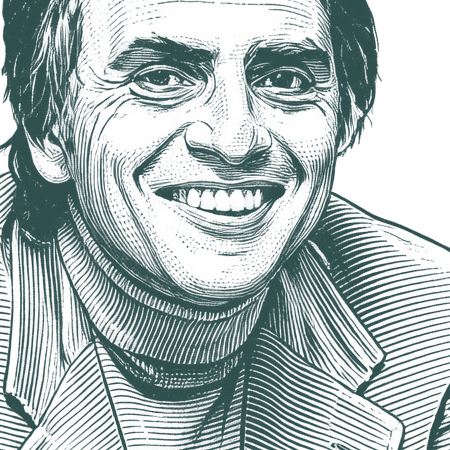
Can you be sure that others have not come before you and destroyed the pristine state of the native myth? Can you be sure that the natives are not hu… - Carl Sagan
""
Can you be sure that others have not come before you and destroyed the pristine state of the native myth? Can you be sure that the natives are not humoring you or pulling your leg? Bronislaw Malinowski thought he had discovered a people in the Trobriant Islands who had not worked out the connection between sexual intercourse and childbirth. When asked how children were conceived, they supplied him with an elaborate mythic structure prominently featuring celestial intervention. Amazed, Malinowski objected that was not how it was done at all, and supplied them instead with the version so popular in the West today – including a nine-month gestation period. “Impossible,” replied the Melanesians. “Do you not see that woman over there with her six-month-old child? Her husband has been on an extended voyage to another island for two years.” Is it more likely that the Melanesians were ignorant of the begetting of children or that they were gently chiding Malinowski? If some peculiar-looking stranger came into my town and asked ME where babies came from, I’d certainly be tempted to tell him about storks and cabbages. Prescientific people are people. Individually they are as clever as we are.
Carl Edward Sagan (9 November 1934 – 20 December 1996) was an American astronomer, planetary scientist, cosmologist, astrophysicist, astrobiologist, author, and science communicator. His best known scientific contribution is research on extraterrestrial life, including experimental demonstration of the production of amino acids from basic chemicals by radiation. Sagan assembled the first physical messages sent into space, the Pioneer plaque and the Voyager Golden Record, universal messages that could potentially be understood by any extraterrestrial intelligence that might find them. Sagan argued the hypothesis, accepted since, that the high surface temperatures of Venus can be attributed to, and calculated using, the greenhouse effect. He testified to the US Congress in 1985 that the greenhouse effect will change the earth's climate system.
Biography information from
Wikiquote·
Portrait adapted from
Wikimedia Commons, NASA/JPL (Public domain / CC0)
Also Known As
Native Name:
Carl Edward Sagan
Alternative Names:
Sagan
•
Carl E. Sagan
•
Carl E Sagan
•
C. E. Sagan
•
C.E. Sagan
•
C E Sagan
•
C. Sagan
•
C Sagan
•
Sagan C
•
Sagan C.
•
Sagan C. E.
•
Sagan CE
It seems to me what is called for is an exquisite balance between two conflicting needs: the most skeptical scrutiny of all hypotheses that are served up to us and at the same time a great openness to new ideas. Obviously those two modes of thought are in some tension. But if you are able to exercise only one of these modes, whichever one it is, you’re in deep trouble.
If you are only skeptical, then no new ideas make it through to you. You never learn anything new. You become a crotchety old person convinced that nonsense is ruling the world. (There is, of course, much data to support you.) But every now and then, maybe once in a hundred cases, a new idea turns out to be on the mark, valid and wonderful. If you are too much in the habit of being skeptical about everything, you are going to miss or resent it, and either way you will be standing in the way of understanding and progress.
On the other hand, if you are open to the point of gullibility and have not an ounce of skeptical sense in you, then you cannot distinguish the useful as from the worthless ones.
The cosmos is full beyond measure of elegant truths; of exquisite interrelationships; of the awesome machinery of nature. The surface of the Earth is the shore of the cosmic ocean. On this shore we've learned most of what we know. Recently we've waded a little way out, maybe ankle deep, and the water seems inviting. Some part of our being knows this is where we came from. We long to return. And we can. Because the cosmos is also within us. We're made of star-stuff. We are a way for the cosmos to know itself.
OUR ANCESTORS UNDERSTOOD origins by extrapolating from their own experience. How else could they have done it? So the Universe was hatched from a cosmic egg, or conceived in the sexual congress of a mother god and a father god, or was a kind of product of the Creator’s workshop — perhaps the latest of many flawed attempts. And the Universe was not much bigger than we see, and not much older than our written or oral records, and nowhere very different from places that we know. We’ve tended in our cosmologies to make things familiar. Despite all our best efforts, we’ve not been very inventive.