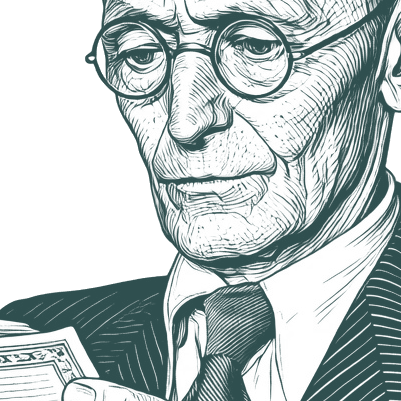
He read the veinings of a leaf, the pattern on a mushroom cap, and divined mysteries, relations, futures, possibilities: the magic of symbols, the fo… - Hermann Hesse

" "

He read the veinings of a leaf, the pattern on a mushroom cap, and divined mysteries, relations, futures, possibilities: the magic of symbols, the foreshadowing of numbers and writing, the reduction of infinitudes and multiplicities to simplicity, to system, to concept. For all these ways of comprehending the world through the mind no doubt lay within him, nameless, unnamed, but not inconceivable, not beyond the bounds of presentiment, still in the germ, but essential to his nature, part of him, growing organically within him. And if we were to go still further back beyond this Rainmaker and his time which to us seems so early and primitive, if we were to go several thousand years further back into the past, wherever we found man we would still find - this is our firm belief - the mind of man, that mind which has no beginning and always has contained everything that it later produces.

English
Collect this quote

About Hermann Hesse

Hermann Karl Hesse (2 July 1877 – 9 August 1962) was a German-Swiss poet, novelist, and painter. In 1946, he received the Nobel Prize in Literature. His most famous works include Steppenwolf, Siddhartha, and The Glass Bead Game (also known as Magister Ludi) all of which explore an individual's search for spirituality.

Biography information from Wikiquote

Also Known As

Native Name: Hermann Karl Hesse
Alternative Names: Hh. Hesse
Unlimited Quote Collections

Organize your favorite quotes without limits. Create themed collections for every occasion with Premium.

Related quotes. More quotes will automatically load as you scroll down, or you can use the load more buttons.

Additional quotes by Hermann Hesse

(We) consist of everything the world consists of, each of us, and just as our body contains the genealogical table of evolution as far back as the fish and even much further, so we bear everything in our soul that once was alive in the soul of men. Every god and devil that ever existed, be it among the Greeks, Chinese, or Zulus, are within us, exist as latent possibilities, as wishes, as alternatives. If the human race were to vanish from the face of the earth save for one halfway talented child that had received no education, this child would rediscover the entire course of evolution, it would be capable of producing everything once more, gods and demons, paradises, commandments, the Old and New Testament.

It was no different with my own life, and with Gertrude's and that of many others. Fate was not kind, life was capricious and terrible, and there was no good or reason in nature. But there is good and reason in us, in human beings, with whom fortune plays, and we can be stronger than nature and fate, if only for a few hours. And we can draw close to one another in times of need, understand and love one another, and live to comfort each other. And sometimes, when the black depths are silent, we can do even more. We can then be gods for moments, stretch out a commanding hand and create things which were not there before and which, when they are created, continue to live without us. Out of sounds, words, and other frail and worthless things, we can construct playthings — songs and poems full of meaning, consolation and goodness, more beautiful and enduring than the grim sport of fortune and destiny. We can keep the spirit of God in our hearts and, at times, when we are full of Him, He can appear in our eyes and our words, and also talk to others who do no know or do not wish to know Him. We cannot evade life's course, but we can school ourselves to be superior to fortune and also to look unflinchingly upon the most painful things.

Loading...