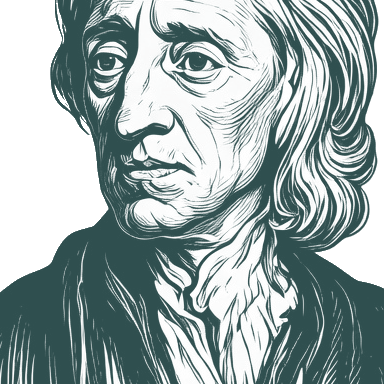
God; I esteem it above all things necessary to distinguish exactly the business of civil government from that of religion and to settle the just boun… - John Locke
""
God; I esteem it above all things necessary to distinguish exactly the business of civil government from that of religion and to settle the just bounds that lie between the one and the other. If this be not done, there can be no end put to the controversies that will be always arising between those that have, or at least pretend to have, on the one side, a concernment for the interest of men’s souls, and, on the other side, a care of the commonwealth.
John Locke (29 August 1632 – 28 October 1704) was an influential English philosopher and social contract theorist. He developed an alternative to the Hobbesian state of nature and asserted a government could be good only if it received the consent of the governed and protected the natural rights of life, liberty, and estate. If such a consent was not achieved, Locke argued in favour of a right of rebellion, which he referred to as an "appeal to heaven".
Biography information from
Wikiquote·
Portrait adapted from
Wikimedia Commons, Godfrey Kneller (Public domain / CC0)
The next thing is by gentle degrees to accustom children to those things they are too much afraid of. But here great caution is to be used, that you do not make too much haste, nor attempt this cure too early, for fear lest you increase the mischief instead of remedying it.
To one that, thus unbiassed, reads the scriptures, what Adam fell from (is visible) was the state of perfect obedience, which is called justice in the New Testament; though the word, which in the original signifies justice, be translated righteousness: and by this fall he lost paradise, wherein was tranquillity and the tree of life; i. e. he lost bliss and immortality.
Enhance Your Quote Experience
Enjoy ad-free browsing, unlimited collections, and advanced search features with Premium.
Whoever has used what means he is capable of, for the informing of himself, with a readiness to believe and obey what shall be taught and prescribed by Jesus, his Lord and King, is a true and faithful subject of Christ's kingdom; and cannot be thought to fail in any thing necessary to salvation.