By substance, I mean that which is in itself, and is conceived through itself: in - Benedictus de Spinoza
""
By substance, I mean that which is in itself, and is conceived through itself: in
English
Collect this quote
About
Benedictus de Spinoza
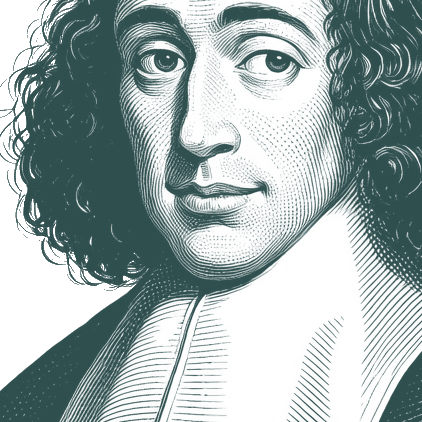
Benedictus de Spinoza (24 November 1632 – 21 February 1677) was a social and metaphysical philosopher known for the elaborate development of his monist philosophy, which has become known as Spinozism. Controversy regarding his ideas led to his excommunication from the Jewish community of his native Amsterdam. He was named Baruch ("blessed" in Hebrew) Spinoza by his synagogue elders and known as Bento de Spinoza or Bento d'Espiñoza, but afterwards used the name Benedictus ("blessed" in Latin) de Spinoza.
Native Name:
בָּרוּךְ שְׂפִּינוֹזָה
•
Benedito de Espinosa
Alternative Names:
Benedict de Spinoza
•
Baruch de Espinosa
•
Barukh Shpinozah
•
Benoît de Spinoza
•
Sbīnūzā
•
Ispīnūzā
•
Barukh Spinoza
•
Bento de Espinosa
•
Baruch d' Espinoza
•
Shpinozah
•
Baruch de Spinoza
•
Spinoza
•
Benoit de Spinoza
•
Benedictus De Spinoza
•
Benedictus Spinoza
•
Baruch Spinoza
•
Baruch Benedictus de Spinoza
Many I believe will wonder at this juxtaposition, not seeing that he is like Spinoza, or that he holds the same conspicuous position in art as Spinoza in science. Without destroying the balance of the Speech, I could only suggest my reason. There is now another reason why I should say no more. During these fifteen years the attention to Spinoza, awakened by Jacobi's writings and continued by many later influences, which was then somewhat marked, has relaxed. Novalis also has again become unknown to many. At that time, however, these examples seemed significant and important. Many coquetted in insipid poetry with religion, believing they were akin to the profound Novalis, just as there were advocates enough of the All in the One taken for followers of Spinoza who were equally distant from their original.
Some important intellectual figures of the day made their way to the modest rooms he rented in the Hague in his last years, including the up-and-coming young go-getter Gottfried Wilhelm Leibniz, who would emerge as one of the most dazzling figures in the seventeenth century's impressive lineup of genius. Leibniz spent a few days with Spinoza, conversing on metaphysics. The only written record of their extensive conversations was a slip of paper on which Leibniz had written down, for Spinoza's approval, a proof for God's existence. Leibniz was profoundly influenced by Spinoza's ideas but sought always to conceal his philosophical debt, and is on record as denouncing the philosopher. When a professor of rhetoric at the University of Utrecht, one Johan Georg Graevius, wrote to Leibniz, castigating the Tractatus Theologico-Politicus as a "most pestilential book," whose author "is said to be a Jew named Spinoza, but who was cast out of the synagogue because of his monstrous opinions," Leibniz prudently chimed in with his own diplomatic calumny: "I have read the book by Spinoza. I am saddened by the fact that such a learned man has, as it seems, sunk so low."
Try QuoteGPT
Chat naturally about what you need. Each answer links back to real quotes with citations.
The ultimate aim of government is not to rule, or restrain, by fear, nor to exact obedience, but contrariwise, to free every man from fear, that he may live in all possible security; in other words, to strengthen his natural right to exist and work without injury to himself or others.