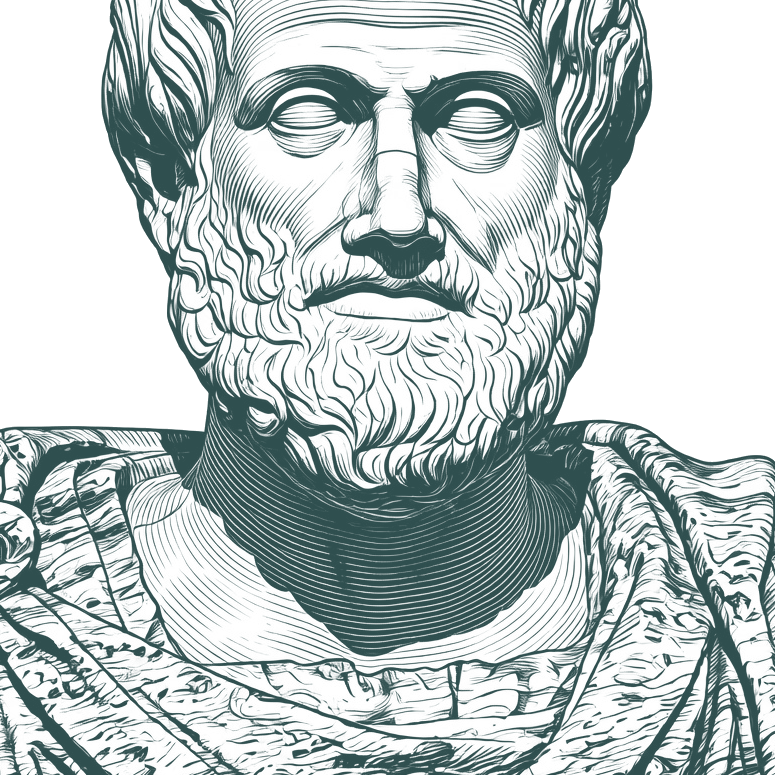
Aristotle (Ἀριστοτέλης Aristotelēs; 384 BC – 322 BC) was a Greek philosopher and polymath during the Classical period in Ancient Greece. Taught by Plato, he was the teacher of Theophrastus and founder of the Lyceum, the Peripatetic school of philosophy, and the Aristotelian tradition. His writings cover many subjects including physics, biology, zoology, metaphysics, logic, ethics, aesthetics, poetry, theatre, music, rhetoric, psychology, linguistics, economics, politics, meteorology, geology and government. Aristotle provided a complex synthesis of the various philosophies existing prior to him. It was above all from his teachings that the West inherited its intellectual lexicon, as well as problems and methods of inquiry. As a result, his philosophy has exerted a unique influence on almost every form of knowledge in the West and it continues to be a subject of contemporary philosophical discussion.
Biography information from
Wikiquote·
Portrait adapted from
Wikimedia Commons, After Lysippos (Public domain / CC0)
Also Known As
Native Name:
Ἀριστοτέλης
Alternative Names:
the Stagirite
•
Aristotelis
•
Aristoteles
What is evil neither can nor should be loved; for it is not one’s duty to be a lover of evil or to become like what is bad; and we have said that like is dear to like. Must the friendship, then, be forthwith broken off? Or is this not so in all cases, but only when one’s friends are incurable in their wickedness? If they are capable of being reformed one should rather come to the assistance of their character or their property, inasmuch as this is better and more characteristic of friendship. But a man who breaks off such a friendship would seem to be doing nothing strange; for it was not to a man of this sort that he was a friend; when his friend changed, therefore, and he is unable to save him, he gives him up.
Speaking generally, we may say that whatever legal enactments are held to be for the interest of various constitutions, all these preserve them. And the great preserving principle is the one which has been repeatedly mentioned- to have a care that the loyal citizen should be stronger than the disloyal. Neither should we forget the mean, which at the present day is lost sight of in perverted forms of government; for many practices which appear to be democratical are the ruin of democracies, and many which appear to be oligarchical are the ruin of oligarchies. Those who think that all virtue is to be found in their own party principles push matters to extremes; they do not consider that disproportion destroys a state. A nose which varies from the ideal of straightness to a hook or snub may still be of good shape and agreeable to the eye; but if the excess be very great, all symmetry is lost, and the nose at last ceases to be a nose at all on account of some excess in one direction or defect in the other; and this is true of every other part of the human body. The same law of proportion equally holds in states. Oligarchy or democracy, although a departure from the most perfect form, may yet be a good enough government, but if any one attempts to push the principles of either to an extreme, he will begin by spoiling the government and end by having none at all. Wherefore the legislator and the statesman ought to know what democratical measures save and what destroy a democracy, and what oligarchical measures save or destroy an oligarchy. For neither the one nor the other can exist or continue to exist unless both rich and poor are included in it. If equality of property is introduced, the state must of necessity take another form; for when by laws carried to excess one or other element in the state is ruined, the constitution is ruined.
Unlimited Quote Collections
Organize your favorite quotes without limits. Create themed collections for every occasion with Premium.
[L]et us consider, with respect to causes, what they are, and how many there are in number... this also must be done by us in discoursing concerning generation and corruption, and all physical mutation... knowing the principles of these... Cause... is after one manner said to be that, from which, being inherent, something is produced... But after another manner cause is form and paradigm (and this is the definition of the essence of a thing) and the genera of this. ...But it happens... that there are also many causes of the same thing, and this is not from accident. ...seed, a physician, he who consults, and, in short, he who makes, are all of them causes, as that whence the principle of mutation, or permanency, or motion is derived. ...It is, however, necessary always to investigate the supreme cause of every thing ...Further still, it is necessary to investigate the genera of genera; and the particulars of particulars... We should also explore the capacities of the capabilities, and the energizers of the things affected by energy.