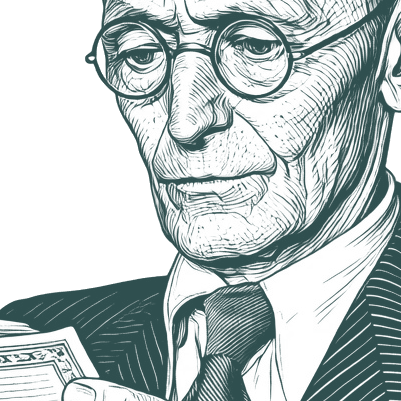
I experienced by observing my own body and my own soul that I sorely needed sin, sorely needed concupiscence, needed greed, vanity, and the most sham… - Hermann Hesse
""
I experienced by observing my own body and my own soul that I sorely needed sin, sorely needed concupiscence, needed greed, vanity, and the most shameful despair to learn to stop resisting, to learn to love the world and stop comparing it to some world I only wished for and imagined, some sort of perfection I myself had dreamed up, but instead to let it be as it was and to love it and be happy to belong to it.
English
Collect this quote
About
Hermann Hesse
Hermann Karl Hesse (2 July 1877 – 9 August 1962) was a German-Swiss poet, novelist, and painter. In 1946, he received the Nobel Prize in Literature. His most famous works include Steppenwolf, Siddhartha, and The Glass Bead Game (also known as Magister Ludi) all of which explore an individual's search for spirituality.
After each symbol conjured up by the director of a Game, each player was required to perform silent, formal meditation on the content, origin, and meaning of this symbol, to call to mind intensively and organically its full purport. The members of the Order and of the Game associations brought the technique and practice of contemplation with them from their elite schools, where the art of contemplation and meditation was nurtured with the greatest care. In this way the hieroglyphs of the Game were kept from degenerating into mere empty signs.
Our leaders strain every nerve and with success, to get the next war going, while the rest of us, meanwhile, dance the fox trot, earn money and eat chocolates...And perhaps...it has always been the same and always will be, and what is called history at school, and all we learn by heart there about heroes and geniuses and great deeds and fine emotions, is all nothing but a swindle invented by the schoolmasters for educational reasons to keep children occupied for a given number of years. It has always been so and always will be. Time and the world, money and power belong to the small people and shallow people. To the rest, to the real men belongs nothing...eternity...it isn't fame. Fame exists in that sense only for the schoolmasters. No, it isn't fame. It is what I call eternity...The music of Mozart belongs there and the poetry of your great poets. The saints, too, belong there, who have worked wonders and suffered martyrdom and given a great example to men. But the image of every true act, the strength of every true feeling, belongs to eternity just as much, even though no one knows of it or sees it or records it or hands it down to posterity. In eternity there is no posterity...It is the kingdom on the other side of time and appearances. It is there we belong. There is our home. It is that which our heart strives for...And we have no one to guide us. Our only guide is our homesickness.
The south winds roars at night, Curlews hasten in their flight, The air is damp and warm. Desire to sleep has vanished now, Spring has arrived in the night In the wake of a storm.