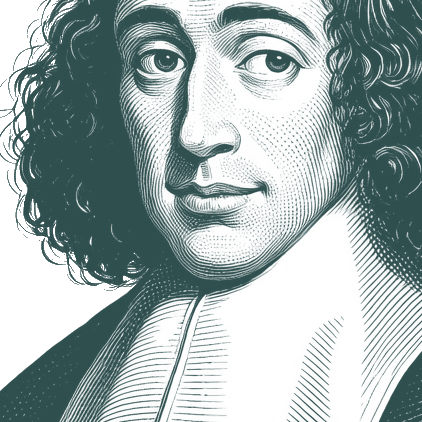
When he arrived in Amsterdam at age fifty-one , Locke had published nothing. During what was clearly a transformational period, he used his time in H… - Benedictus de Spinoza
""
When he arrived in Amsterdam at age fifty-one , Locke had published nothing. During what was clearly a transformational period, he used his time in Holland to talk with other independent thinkers who had been hounded into exile by the governments and churches of their own countries. Although Spinoza was dead, Locke certainly met many of the philosopher's admirers and enemies. He was well acquainted with nonconformist Protestant Collegiants, and his later writings would advocate complete toleration for all forms of Protestantism. At the time of Locke's death, his library contained all of Spinoza's published works as well as many political and religious disputations, in many languages, in which Spinoza's ideas were vigorously debated. Locke, like Hobbes, Adam Smith, and David Hume, is much more widely recognized than Spinoza in the United States as an influence upon the Enlightenment views of the American founders, but the more radical Spinoza's voice can be heard in both the Declaration of Independence and the Bill of Rights. It is not surprising that Thomas Jefferson's library contained Spinoza's collected works, which were more readily available at the end of the eighteenth century than in Locke's time.
English
Collect this quote
About
Benedictus de Spinoza
Benedictus de Spinoza (24 November 1632 – 21 February 1677) was a social and metaphysical philosopher known for the elaborate development of his monist philosophy, which has become known as Spinozism. Controversy regarding his ideas led to his excommunication from the Jewish community of his native Amsterdam. He was named Baruch ("blessed" in Hebrew) Spinoza by his synagogue elders and known as Bento de Spinoza or Bento d'Espiñoza, but afterwards used the name Benedictus ("blessed" in Latin) de Spinoza.
Native Name:
בָּרוּךְ שְׂפִּינוֹזָה
•
Benedito de Espinosa
Alternative Names:
Benedict de Spinoza
•
Baruch de Espinosa
•
Barukh Shpinozah
•
Benoît de Spinoza
•
Sbīnūzā
•
Ispīnūzā
•
Barukh Spinoza
•
Bento de Espinosa
•
Baruch d' Espinoza
•
Shpinozah
•
Baruch de Spinoza
•
Spinoza
•
Benoit de Spinoza
•
Benedictus De Spinoza
•
Benedictus Spinoza
•
Baruch Spinoza
•
Baruch Benedictus de Spinoza
He flew through the nets of Judaism, Calvinism, Aristotelianism and the Cartesian dualism, but nevertheless Descartes was his starting point. Could he have become Spinoza without Descartes? Did he beget himself, as Socrates did, or even as Hobbes largely was self-generated? Spinoza's "Nature or God" is not one of the Cartesian formulations, but Spinoza relies upon a number of Cartesian concepts.
— — - susmak da konuşmak da insanın elinde olsaydı bu dünya sahiden çok daha mutlu bir dünya olurdu. Ama yaşam bize defalarca göstermiştir ki, insan dilinden başka her şeye daha çok hakim ve başka her şeyi yapabiliyor da bir tek arzularına gem vuramıyor. — — — Gıpta, başkalarının da arzuladığını hayal ettiğimiz bir şeye karşı içimizde uyanan arzudur. Başkalarının kaçtığını gördüğünde kaçan, başkalarının korktuğunu gördüğünde korkan, hatta başkasının elinin yandığını gördüğünde kendi elini çekip bedenini sanki kendi eli yanmış gibi oynatan insana başkasının hareketlerini taklit ediyor deriz, başkasına gıpta ediyor demeyiz; gıpta etmenin ve taklit etmenin nedenlerinin farklı olduğunu bilmemizden değil tabii, sadece bize soylu, yararlı ya da hoş gelen bir şeyi taklit eden insana gıpta ediyor demek adet olmuştur da ondan. — — -
sadece yoksunluk açısından uyuşan şeyler, yani sahip olmadıklan özellikler açısından uyuşan şeyler gerçekte hiçbir açıdan uyuşmazlar. — — -
Hırslı adam hiçbir konuda ölçülü olmayacaktır, yeter ki yakalanmayacağına dair umudu olsun; hele ayyaşların ve şehvet düşkünlerinin arasında yaşayıp gidiyorsa, zaten kendisi de hırslı olduğundan, onların kusurlarına daha fazla meyledecektir. ... Yoksul insan bir de hırslıysa artık hiç susmadan sürekli paranın kötüye kullanımından, zenginlerin ahlaksızlıklarından konuşup durur. Ama böyle yaparak sadece kendisine işkence çektirir ve sadece kendi yoksulluğuna değil başkalarının zenginliğine de nasıl tahammül gösteremediğini açığa vurur. Sevgilisi tarafından beklediği ilgiyi göremeyenler de böyle yapar, kadınların kararsızlıklarından, yalancılıklarından ve bunun gibi dile pelesenk olan başka kusurlarından başka hiçbir şey düşünemez olur, ama sevgilisi tarafından yeniden kabul gördüklerinde de bütün bu düşündüklerini bir anda unutuverir. — — -
acı da iyi bir duygudur, çünkü incinen kısmın henüz çürümemiş olduğunu gösterir. — — -
Go Premium
Support Quotewise while enjoying an ad-free experience and premium features.
Twenty-some years ago, when at the age of forty I returned to the study of the Ethics, which had been 'my book' during adolescence, the theoretical climate in which I found myself immersed had changed to such an extent that it was difficult to tell if the Spinoza standing before me then was the same one who had accompanied me in my earliest studies.