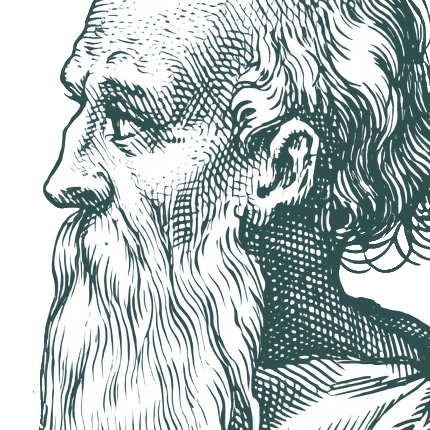
Now there are two kinds of hardening, one of the understanding, the other of the sense of shame, when a man is resolved not to assent to what is mani… - Epictetus
""
Now there are two kinds of hardening, one of the understanding, the other of the sense of shame, when a man is resolved not to assent to what is manifest nor to desist from contradictions. Most of us are afraid of mortification of the body, and would contrive all means to avoid such a thing, but we care not about the soul's mortification. And indeed with regard to the soul, if a man be in such a state as not to apprehend anything, or understand at all, we think that he is in a bad condition; but if the sense of shame and modesty are deadened, this we call even power (or strength).
Epictetus (c. 55 – c. 135 AD), born a slave, was a Greek Stoic philosopher. His words were recorded by his student Arrian in the Discourses and Enchiridion written in the early 2nd-century.
Biography information from
Wikiquote·
Portrait adapted from
Wikimedia Commons, Theodoor Galle (Public domain / CC0)
Also Known As
Native Name:
ΕΠΙΚΤΗΤΟΣ
Alternative Names:
Epictetus of Hierapolis
•
Epiktetos
Nadie puede herirte si tú no lo consientes. Sólo te lastimarán si crees que has sido lastimado. De esta manera no le guardarás rencor a tu prójimo, ya que tú serás quien controle cada sensación que pueda provocarse por la actitud de este.
But it would be beneath my dignity.’ Well, that is an additional factor that you bring to the question, not me. You are the one who knows yourself – which is to say, you know how much you are worth in your own estimation, and therefore at what price you will sell yourself; because people sell themselves at different rates.
Thus, whatever phase of things human and divine you have apprehended, you will be wearied by the vast number of things to be answered and things to be learned. And in order that these manifold and mighty subjects may have free entertainment in your soul, you must remove therefrom all superfluous things. Virtue will not surrender herself to these narrow bounds of ours; a great subject needs wide space in which to move. Let all other things be driven out, and let the breast be emptied to receive virtue.