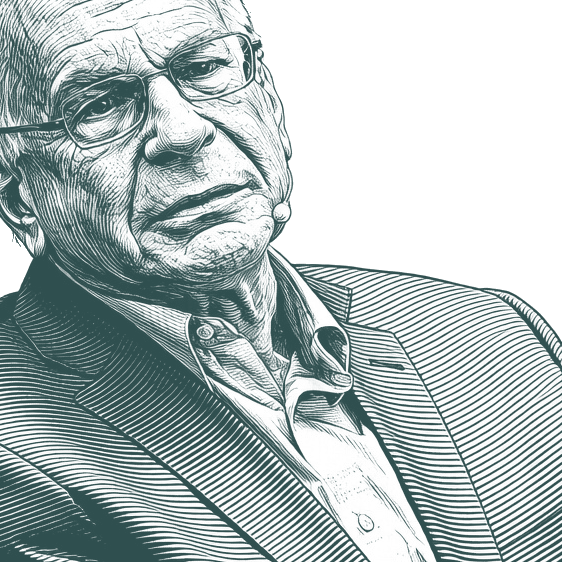
A general limitation of the human mind is its imperfect ability to reconstruct past states of knowledge, or beliefs that have changed. Once you adopt… - Daniel Kahneman
""
A general limitation of the human mind is its imperfect ability to reconstruct past states of knowledge, or beliefs that have changed. Once you adopt a new view of the world (or of any part of it), you immediately lose much of your ability to recall what you used to believe before your mind changed.
Daniel Kahneman (March 5, 1934 – March 27, 2024) was an Israeli-American psychologist. He shared the 2002 Nobel Memorial Prize in Economic Sciences with Vernon L. Smith. Kahneman is notable for his work on the psychology of judgment and decision-making, behavioral economics and hedonic psychology. Latterly, he was professor emeritus of psychology and public affairs at Princeton University's Woodrow Wilson School.
The prominence of causal intuitions is a recurrent theme in this book because people are prone to apply causal thinking inappropriately, to situations that require statistical reasoning.
"If you care about being thought credible and intelligent, do not use complex language where simpler language will do. My Princeton colleague Danny Oppenheimer refuted a myth prevalent among undergraduates about the vocabulary that professors find most impressive. In an article titled "Consequences of Erudite Vernacular Utilized Irrespective of Necessity: Problems with Using Long Words Needlessly," he showed that couching familiar ideas in pretentious language is taken as a sign of poor intelligence and low credibility."
Works in ChatGPT, Claude, or Any AI
Add semantic quote search to your AI assistant via MCP. One command setup.