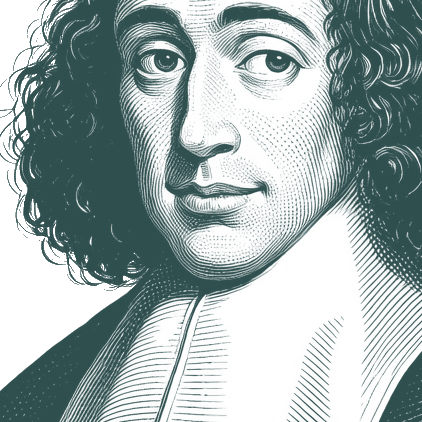
I confess without hesitation my dependence regarding the teachings of Spinoza. If I never cared to cite his name directly, it is because I never drew… - Benedictus de Spinoza
""
I confess without hesitation my dependence regarding the teachings of Spinoza. If I never cared to cite his name directly, it is because I never drew the tenets of my thinking from the study of that author but rather from the atmosphere he created.
English
Collect this quote
About
Benedictus de Spinoza
Benedictus de Spinoza (24 November 1632 – 21 February 1677) was a social and metaphysical philosopher known for the elaborate development of his monist philosophy, which has become known as Spinozism. Controversy regarding his ideas led to his excommunication from the Jewish community of his native Amsterdam. He was named Baruch ("blessed" in Hebrew) Spinoza by his synagogue elders and known as Bento de Spinoza or Bento d'Espiñoza, but afterwards used the name Benedictus ("blessed" in Latin) de Spinoza.
Native Name:
בָּרוּךְ שְׂפִּינוֹזָה
•
Benedito de Espinosa
Alternative Names:
Benedict de Spinoza
•
Baruch de Espinosa
•
Barukh Shpinozah
•
Benoît de Spinoza
•
Sbīnūzā
•
Ispīnūzā
•
Barukh Spinoza
•
Bento de Espinosa
•
Baruch d' Espinoza
•
Shpinozah
•
Baruch de Spinoza
•
Spinoza
•
Benoit de Spinoza
•
Benedictus De Spinoza
•
Benedictus Spinoza
•
Baruch Spinoza
•
Baruch Benedictus de Spinoza
The mind of God is all the mentality that is scattered over space and time, the diffused consciousness that animates the world.
...For natural science he [Otto von Bismarck] shewed little interest, and indeed at that time it scarcely could be reckoned among the ordinary subjects of education; philosophy he pursued rather as a man than as a student, and we are not surprised to find that it was Spinoza rather than Kant or Fichte or Hegel to whom he devoted most attention, for he cared more for principles of belief and the conduct of life than the analysis of the intellect. ...He [Otto von Bismarck] astonished his friends by the amount and variety of his reading; it was at this time that he studied Spinoza. It is said that he had among his friends the reputation of being a liberal; it is probable enough that he said and did many things which they did not understand; and anything they did not understand would be attributed to liberalism by the country gentlemen of Pomerania; partly no doubt it was due to the fact that in 1843 he came back from Paris wearing a beard.
Works in ChatGPT, Claude, or Any AI
Add semantic quote search to your AI assistant via MCP. One command setup.
...We must mention the providential man who, at the same time as Locke and Leibnitz, had educated himself in the school of Descartes, had for a long time been viewed only with scorn and hatred, and who nevertheless today is rising to exclusive supremacy in the world of intellect. I am speaking about Benedict Spinoza. One great genius shapes himself by means of another, less through assimilation than through friction. One diamond polishes the other. Thus Descartes' philosophy did not originate, but merely furthered, Spinoza's. Hence we find in the pupil, first of all, the method of the master; this is a great gain. We also find in Spinoza, as in Descartes, a method of demonstration borrowed from mathematics. This is a great defect. The mathematical form gives Spinoza's work a harsh exterior. But this is like the hard shell of the almond; the kernel is all the more delightful. On reading Spinoza we are seized by an emotion similar to that which we feel at the sight of great Nature in her most animated composure. A forest of heaven‑aspiring thoughts whose blossoming treetops are tossing like waves, while the immovable trunks are rooted in the eternal earth. There is a certain mysterious aura about Spinoza's writings. The air of the future seems to flow over us. Perhaps the spirit of the Hebrew prophets still hovered over their late‑born descendant. There is, withal, a seriousness in him, a confident pride, a solemn dignity of thought, which also seem to be a part of his inheritance; for Spinoza belonged to one of those martyr families exiled from Spain by the most Catholic of kings. Added to this is the patience of the Hollander, which was always revealed in the life of the man as well as in his writings. It is a fact that Spinoza's life was beyond reproach and pure and spotless as the life of his divine cousin, Jesus Christ. Like Him, he too suffered for his teachings; like Him he wore the crown of thorns. Wherever a great mind expresses its thought, there is Golgotha.