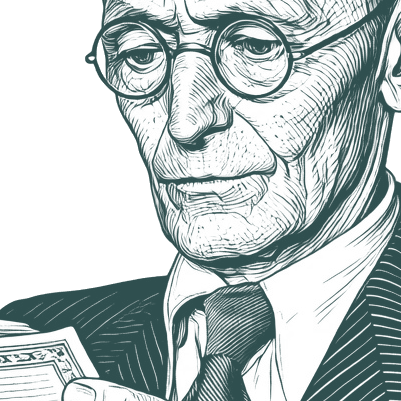
One thing, however, did become clear to him — why so many perfect works of art did not please him at all, why they were almost hateful and boring to … - Hermann Hesse
""
One thing, however, did become clear to him — why so many perfect works of art did not please him at all, why they were almost hateful and boring to him, in spite of a certain undeniable beauty. Workshops, churches, and palaces were full of these fatal works of art; he had even helped with a few himself. They were deeply disappointing because they aroused the desire for the highest and did not fulfill it. They lacked the most essential thing — mystery. That was what dreams and truly great works of art had in common: mystery.
Hermann Karl Hesse (2 July 1877 – 9 August 1962) was a German-Swiss poet, novelist, and painter. In 1946, he received the Nobel Prize in Literature. His most famous works include Steppenwolf, Siddhartha, and The Glass Bead Game (also known as Magister Ludi) all of which explore an individual's search for spirituality.
Yes Siddhartha,' he said. 'Is this what you mean: that the river is in all places at once, at its source and where it flows into the sea, at the waterfall, at the ferry, at the rapids, in the ocean, in the mountains, everywhere at once, so for the river there is only the present moment and not the shadow of the future?'
'It is,' Siddhartha said.'And once I learned this I considered my life, and it too was a river, and the boy Siddhartha was separated from the man Siddhartha and the graybeard Siddhartha only by shadows, not by real things. ... Nothing was, nothing will be; everything is, everything has being and presence.
Human life is reduced to real suffering, to hell, only when two ages, two cultures and religions overlap.
Limited Time Offer
Premium members can get their quote collection automatically imported into their Quotewise collections.