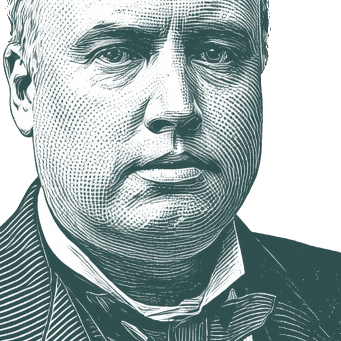
The superior man is the providence of the inferior. He is eyes for the blind, strength for the weak, and a shield for the defenseless. He stands erec… - Robert Green Ingersoll
""
The superior man is the providence of the inferior. He is eyes for the blind, strength for the weak, and a shield for the defenseless. He stands erect by bending above the fallen. He rises by lifting others.
English
Collect this quote
About
Robert Green Ingersoll
Robert Green Ingersoll (August 11, 1833 – July 21, 1899) was a lawyer, a Civil War veteran, political leader, and orator of the United States during the Golden Age of Freethought, noted for his broad range of culture and his defense of agnosticism. He was nicknamed "The Great Agnostic".
Biography information from
Wikiquote·
Portrait adapted from
Wikimedia Commons, Mathew Benjamin Brady / Levin Corbin Handy (Public domain / CC0)
Also Known As
Alternative Names:
Robert Ingersoll
•
The Great Agnostic
•
Robert G. Ingersoll
Portrait from Wikimedia Commons. Credit: Mathew Benjamin Brady / Levin Corbin Handy. Used under Public domain / CC0. Processed and styled by Quotewise.
Works in ChatGPT, Claude, or Any AI
Add semantic quote search to your AI assistant via MCP. One command setup.
Religions are for a day. They are the clouds. Humanity is the eternal blue. Religions are the waves of the sea. These waves depend upon the force and direction of the wind -- that is to say, of passion; but Humanity is the great sea. And so our religions change from day to day, and it is a blessed thing that they do. Why? Because we grow, and we are getting a little more civilized every day, -- and any man that is not willing to let another man express his opinion, is not a civilized man, and you know it. Any man that does not give to everybody else the rights he claims for himself, is not an honest man.
The Mosaic dispensation was better adapted to prevent the commission of sin than the Christian system. Under that dispensation, if you committed a sin, you had to bring a sacrifice—dove, sheep, or bullock, now, when a sin is committed, the Christian says, “Charge it,” “Put it on the slate, If I don’t pay it the Savior will.” In this way, rascality is sold on a credit, and the credit system of religion breeds extravagance in sin. The Mosaic dispensation was based upon far better business principles. The debt had to be paid, and by the man who owed it. We are told that the sinner is in debt to God, and that the obligation is discharged by the Savior. The best that can be said of such a transaction is that the debt is transferred, not paid. As a matter of fact, the sinner is in debt to the person he has injured. If you injure a man, it is not enough to get the forgiveness of God—you must get the man’s forgiveness, you must get your own. If a man puts his hand in the fire and God forgives him, his hand will smart just as badly.
Go Premium
Support Quotewise while enjoying an ad-free experience and premium features.
In the progress of mankind, the few have been the nearest right. There have been centuries in which the light seemed to emanate only from a handful of men, while the rest of the world was enveloped in darkness. Some great man leads the way—he becomes the morning star, the prophet of a coming day. Afterward, many millions accept his views. But there are still heights above and beyond; there are other pioneers, and the old day, in comparison with the new, becomes a night. So, we cannot say that success demonstrates either divine origin or supernatural aid.