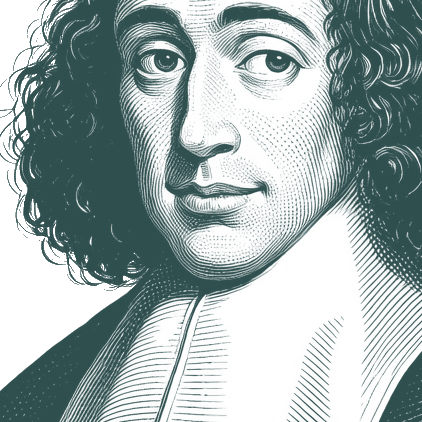
...We may deny his conclusions; we may consider his system of thought preposterous and even pernicious, but we cannot refuse him the respect which is… - Benedictus de Spinoza
""
...We may deny his conclusions; we may consider his system of thought preposterous and even pernicious, but we cannot refuse him the respect which is the right of all sincere and honourable men. [...] Spinoza's influence over European thought is too great to be denied or set aside...
English
Collect this quote
About
Benedictus de Spinoza
Benedictus de Spinoza (24 November 1632 – 21 February 1677) was a social and metaphysical philosopher known for the elaborate development of his monist philosophy, which has become known as Spinozism. Controversy regarding his ideas led to his excommunication from the Jewish community of his native Amsterdam. He was named Baruch ("blessed" in Hebrew) Spinoza by his synagogue elders and known as Bento de Spinoza or Bento d'Espiñoza, but afterwards used the name Benedictus ("blessed" in Latin) de Spinoza.
Native Name:
בָּרוּךְ שְׂפִּינוֹזָה
•
Benedito de Espinosa
Alternative Names:
Benedict de Spinoza
•
Baruch de Espinosa
•
Barukh Shpinozah
•
Benoît de Spinoza
•
Sbīnūzā
•
Ispīnūzā
•
Barukh Spinoza
•
Bento de Espinosa
•
Baruch d' Espinoza
•
Shpinozah
•
Baruch de Spinoza
•
Spinoza
•
Benoit de Spinoza
•
Benedictus De Spinoza
•
Benedictus Spinoza
•
Baruch Spinoza
•
Baruch Benedictus de Spinoza
Marx's Spinozistic affinities were already present in the left-Hegelian milieu in which he grew and from which he took his departure. The radical young Hegelians brought man back to Spinoza's natura from what they saw as the abstract heights of Hegel's Geist, and proclaimed a unity of spirit and matter which was considered an essential Spinozistic principle and which led some of them to socialist conclusions. [...] Spinoza was a left-Hegelian hero. "The Moses of modern freethinkers and materialists"—so Ludwig Feuerbach, a major influence on the young Marx, anointed Spinoza. Unquestionably, Feuerbach thought of himself in the same terms. Spinoza appealed to left-Hegelians both in his negative and his positive philosophy.
Peace is not the absence of war, but a virtue based on strength of character.
Unlimited Quote Collections
Organize your favorite quotes without limits. Create themed collections for every occasion with Premium.
...To the extent that we are committed to the ideal of a secular society free of ecclesiastic influence and governed by toleration, liberty, and a conception of civic virtue; and insofar as we think of true religious piety as consisting in treating other human beings with dignity and respect, and regard the Bible simply as a profound work of human literature with a universal moral message, we are the heirs of Spinoza's scandalous treatise [Tractatus Theologico-Politicus].