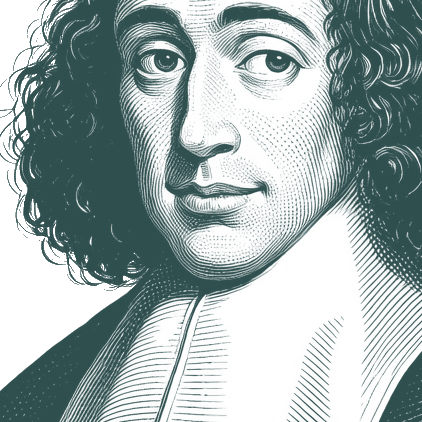
Nature as conceived by many ecologists, and expressed philosophically by James Lovelock and others, is not the passive, dead, value-neutral nature of… - Benedictus de Spinoza
""
Nature as conceived by many ecologists, and expressed philosophically by James Lovelock and others, is not the passive, dead, value-neutral nature of mechanistic science but is akin to the active, "naturing" nature of Spinoza. It is all-inclusive, creative (as natura naturans), infinitely diverse, and alive in the broad sense of Spinozistic so-called panpsychism.
English
Collect this quote
About
Benedictus de Spinoza
Benedictus de Spinoza (24 November 1632 – 21 February 1677) was a social and metaphysical philosopher known for the elaborate development of his monist philosophy, which has become known as Spinozism. Controversy regarding his ideas led to his excommunication from the Jewish community of his native Amsterdam. He was named Baruch ("blessed" in Hebrew) Spinoza by his synagogue elders and known as Bento de Spinoza or Bento d'Espiñoza, but afterwards used the name Benedictus ("blessed" in Latin) de Spinoza.
Native Name:
בָּרוּךְ שְׂפִּינוֹזָה
•
Benedito de Espinosa
Alternative Names:
Benedict de Spinoza
•
Baruch de Espinosa
•
Barukh Shpinozah
•
Benoît de Spinoza
•
Sbīnūzā
•
Ispīnūzā
•
Barukh Spinoza
•
Bento de Espinosa
•
Baruch d' Espinoza
•
Shpinozah
•
Baruch de Spinoza
•
Spinoza
•
Benoit de Spinoza
•
Benedictus De Spinoza
•
Benedictus Spinoza
•
Baruch Spinoza
•
Baruch Benedictus de Spinoza
In the reproach that Hegel will make to Spinoza, that he ignored the negative and its power, lies the glory and innocence of Spinoza, his own discovery. In a world consumed by the negative, he has enough confidence in life, in the power of life, to challenge death, the murderous appetite of men, the rules of good and evil, of the just and the unjust. Excommunication, war, tyranny, reaction, men who fight for their enslavement as if it were their freedom — this forms the world in which Spinoza lives. The assassination of the De Witt brothers is exemplary for him. Ultimi barbarorum. In his view, all the ways of humiliating and breaking life , all the forms of the negative have two sources, one turned outward and the other inward, resentment and bad conscience, hatred and guilt. "The two archenemies of the human race, Hatred and Remorse." He denounces these sources again and again as being linked to man's consciousness, as being inexhaustible until there is a new consciousness, a new vision, a new appetite for living. Spinoza feels, experiences, that he is eternal.
Instead of engaging in this rather boring academic exercise of opposing Spinoza and Levinas, what I want to accomplish is a consciously old-fashioned Hegelian reading of Spinoza - what both Spinozeans and Levinasians share is radical anti-Hegelianism. My starting hypothesis is that, in the history of modern thought, the triad of paganism-Judaism-Christianity repeats itself twice, first as Spinoza-Kant-Hegel, then as Deleuze-Derrida-Lacan. Deleuze deploys the One-Substance as the indifferent medium of multitude; Derrida inverts it into the radical Otherness which differs from itself; finally, in a kind of "negation of negation," Lacan brings back the cut, the gap, into the One itself. The point is not so much to play Spinoza and Kant against each other, thus securing the triumph of Hegel; it is rather to present the three philosophical positions in all their unheard-of radicality - in a way, the triad Spinoza-Kant-Hegel does encompass the whole of philosophy.
Works in ChatGPT, Claude, or Any AI
Add semantic quote search to your AI assistant via MCP. One command setup.
Hatred is increased by being reciprocated, and can on the other hand be destroyed by love. Hatred which is completely vanquished by love, passes into love; and love is thereupon greater, than id hatred had not preceded it.