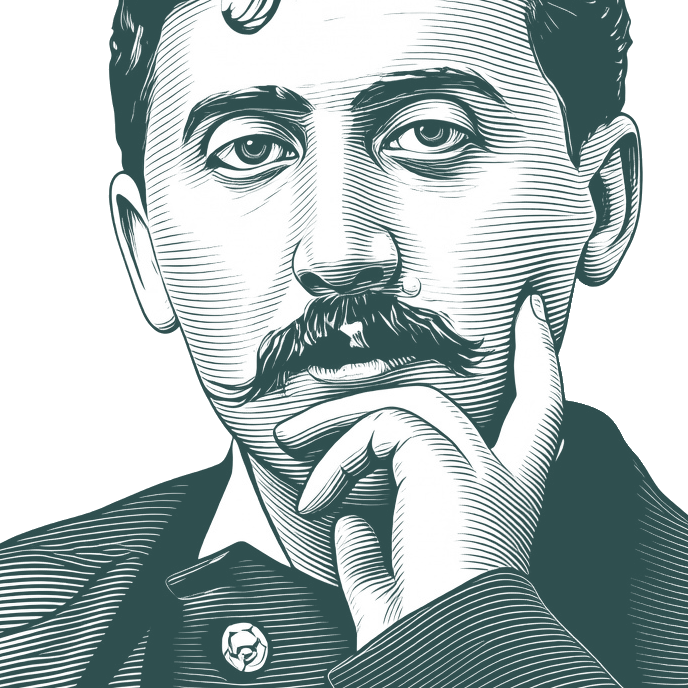
Valentin Louis Georges Eugène Marcel Proust (10 July 1871 – 18 November 1922) was a French novelist, essayist and critic.
Biography information from
Wikiquote·
Portrait adapted from
Wikimedia Commons, Otto Wegener (Public domain / CC0)
Also Known As
Alternative Names:
Valentin Louis Georges Eugène Marcel Proust
•
Proust
•
Valentin Louis Georges Eugéne Marcel Proust
•
Valentin-Louis-Georges-Eugéne-Marcel Proust
•
Valentin Louis Georges Eugene Marcel Proust
•
Valentin-Louis-Georges-Eugene-Marcel Proust
•
Bernard d'Algouvres
•
Valentin-Louis-Georges-Eugène-Marcel Proust
There is no idea that does not carry in itself a possible refutation, no word that does not imply its opposite.
This dim coolness of my room was to the broad daylight of the street what the shadow is to the sunbeam, that is to say equally luminous, and presented to my imagination the entire panorama of summer, which my senses, if I had been out walking, could have tasted and enjoyed only piecemeal; and so it was quite in harmony with my state of repose which (thanks to the enlivening adventures related in my books) sustained, like a hand reposing motionless in a stream of running water, the shock and animation of a torrent of activity.
Enhance Your Quote Experience
Enjoy ad-free browsing, unlimited collections, and advanced search features with Premium.
A man is not more entitled to be "received in good society," or at least to wish to be, because he is more intelligent and cultivated. This is one of those sophisms that the vanity of intelligent people picks up in the arsenal of their intelligence to justify their basest inclinations. In other words, having become more intelligent creates some rights to be less. Very simply, diverse personalities are to be found in the breast of each of us, and often the life of more than one superior man is nothing but the coexistence of a philosopher and a snob. Actually, there are very few philosophers and artists who are absolutely detached from ambition and respect for power, from "people of position." And among those who are more delicate or more sated, snobism replaces ambition and respect for power in the same way superstition arises on the ruins of religious beliefs. Morality gains nothing there. Between a worldly philosopher and a philosopher intimidated by a minister of state, the second is still the more innocent.