Try QuoteGPT
Chat naturally about what you need. Each answer links back to real quotes with citations.
" "Some day you will think of what I am going to say to you now: our friendship has no other purpose, no other reason, than to show you how utterly unlike me you are.
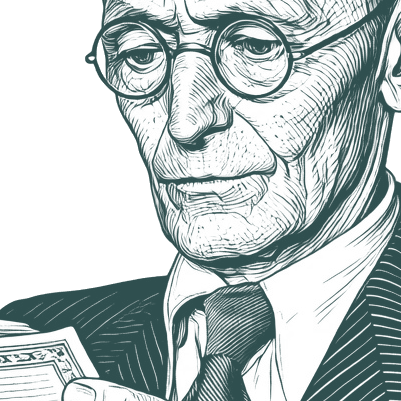
Hermann Karl Hesse (2 July 1877 – 9 August 1962) was a German-Swiss poet, novelist, and painter. In 1946, he received the Nobel Prize in Literature. His most famous works include Steppenwolf, Siddhartha, and The Glass Bead Game (also known as Magister Ludi) all of which explore an individual's search for spirituality.
Biography information from Wikiquote
Chat naturally about what you need. Each answer links back to real quotes with citations.
Related quotes. More quotes will automatically load as you scroll down, or you can use the load more buttons.
Under the shifting hegemony of now this, now that science or art, the Game of games had developed into a kind of universal language through which the players could express values and set these in relation to one another. Throughout its history the Game was closely allied with music, and usually proceeded according to musical and mathematical rules. One theme, two themes, or three themes were stated, elaborated, varied, and underwent a development quite similar to that of the theme in a Bach fugue or a concerto movement. A Game, for example, might start from a given astronomical configuration, or from the actual theme of a Bach fugue, or from a sentence out of Leibniz or the Upanishads, and from this theme, depending on the intentions and talents of the player, it could either further explore and elaborate the initial motif or else enrich its expressiveness by allusions to kindred concepts. Beginners learned how to establish parallels, by means of the Game's symbols, between a piece of classical music and the formula for some law of nature. Experts and Masters of the Game freely wove the initial theme into unlimited combinations.
En estos momentos tuve una certeza fulminante: cada uno tenía una “misión”, pero ésta no podía ser elegida, definida, administrada a voluntad. Era un error desear nuevos dioses, y completamente falso querer dar algo al mundo. No existía ningún deber, ninguno, para el hombre consciente, excepto el de buscarse a sí mismo, afirmarse en su interior, tantear un camino hacia adelante sin preocuparse de la meta a que pudiera conducir. Aquel descubrimiento me conmovió profundamente, este fue el fruto de aquella experiencia. Yo había jugado a menudo con imágenes del futuro y soñado con papeles que pudieran estar destinados de poeta quizás, de profeta, de pintor o de cualquier otra cosa. Aquellas imágenes no valían nada. Yo no estaba en el mundo para escribir, predicar o pintar; ni yo ni nadie estaba para eso. Tales cosas sólo podían surgir marginalmente. La misión verdadera de cada uno era llegar a sí mismo. Se podía llegar a poeta o a loco, a profeta o a criminal; ese no es asunto de uno: a fin de cuentas, carecía de toda importancia. Lo que importaba era encontrar su propio destino, no un destino cualquiera, y vivirlo por completo. Todo lo demás eran medianías, un intento de evasión, de buscar refugio en el ideal de la masa, era amoldarse; era miedo ante la propia individualidad. La nueva imagen surgió terrible y sagrada ante mis ojos, presentido múltiples veces, quizás pronunciada ya otras tantas, pero nunca vivida hasta ahora. Yo era un proyecto de la naturaleza, un proyecto hacia lo desconocido, quizá hacia lo nuevo, quizá hacia la nada; y mi misión, mi única misión, era dejar realizarse este proyecto que brotaba de las profundidades. Sentir en mí su voluntad e identificarme con él por completo.