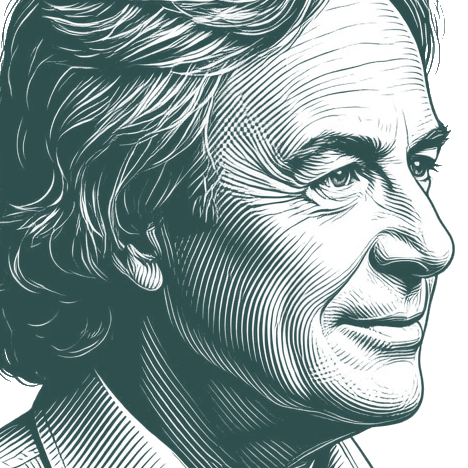
A poet once said, "The whole universe is in a glass of wine." We will probably never know in what sense he meant that, for poets do not write to be u… - Richard Feynman
""
A poet once said, "The whole universe is in a glass of wine." We will probably never know in what sense he meant that, for poets do not write to be understood. But it is true that if we look at a glass of wine closely enough we see the entire universe. There are the things of physics: the twisting liquid which evaporates depending on the wind and weather, the reflections in the glass, and our imagination adds the atoms. The glass is a distillation of the Earth's rocks, and in its composition we see the secrets of the universe's age, and the evolution of stars. What strange arrays of chemicals are in the wine? How did they come to be? There are the ferments, the enzymes, the substrates, and the products. There in wine is found the great generalization: all life is fermentation. Nobody can discover the chemistry of wine without discovering, as did Louis Pasteur, the cause of much disease. How vivid is the claret, pressing its existence into the consciousness that watches it! If our small minds, for some convenience, divide this glass of wine, this universe, into parts — physics, biology, geology, astronomy, psychology, and so on — remember that nature does not know it! So let us put it all back together, not forgetting ultimately what it is for. Let it give us one more final pleasure: drink it and forget it all!
Richard Phillips Feynman (May 11, 1918 – February 15, 1988) was an American theoretical physicist. He is known for the work he did in the path integral formulation of quantum mechanics, the theory of quantum electrodynamics, the physics of the superfluidity of supercooled liquid helium, and in particle physics, for which he proposed the parton model. For his contributions to the development of quantum electrodynamics, Feynman received the Nobel Prize in Physics in 1965 jointly with Julian Schwinger and Shin'ichirō Tomonaga. Feynman developed a widely used pictorial representation scheme for the mathematical expressions describing the behavior of subatomic particles, which later became known as Feynman diagrams. During his lifetime, Feynman became one of the best-known scientists in the world.
Biography information from
Wikiquote·
Portrait adapted from
Wikimedia Commons, Copyright Tamiko Thiel 1984 (CC BY-SA)
Also Known As
Pen Names:
Ofey
Native Name:
Richard Phillips Feynman
Alternative Names:
Feynman
•
Dick Feynman
•
Richard P. Feynman
I have a friend who's an artist, and he sometimes takes a view which I don't agree with. He'll hold up a flower and say, "Look how beautiful it is," and I'll agree. But then he'll say, "I, as an artist, can see how beautiful a flower is. But you, as a scientist, take it all apart and it becomes dull." I think he's kind of nutty. ... There are all kinds of interesting questions that come from a knowledge of science, which only adds to the excitement and mystery and awe of a flower. It only adds. I don't understand how it subtracts.
What I cannot build. I do not understand.
There's a big difference between knowing the name of something and knowing something.