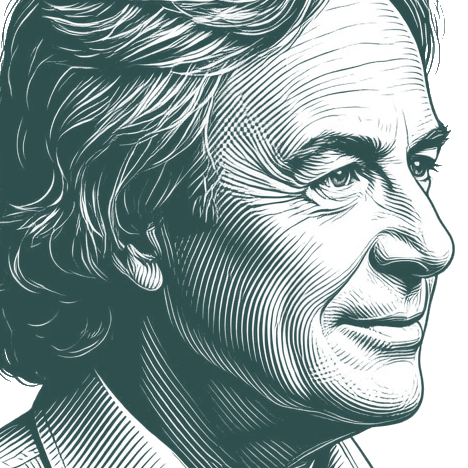
I said, “There’s a long tradition behind life in India that comes from a religion and philosophy that is thousands of years old. And although these p… - Richard Feynman
""
I said, “There’s a long tradition behind life in India that comes from a religion and philosophy that is thousands of years old. And although these people are not in India, they still pass on those traditions about what’s important in life — trying to build for the future and supporting their children in the effort — which have come down to them for centuries.
English
Collect this quote
About
Richard Feynman
Richard Phillips Feynman (May 11, 1918 – February 15, 1988) was an American theoretical physicist. He is known for the work he did in the path integral formulation of quantum mechanics, the theory of quantum electrodynamics, the physics of the superfluidity of supercooled liquid helium, and in particle physics, for which he proposed the parton model. For his contributions to the development of quantum electrodynamics, Feynman received the Nobel Prize in Physics in 1965 jointly with Julian Schwinger and Shin'ichirō Tomonaga. Feynman developed a widely used pictorial representation scheme for the mathematical expressions describing the behavior of subatomic particles, which later became known as Feynman diagrams. During his lifetime, Feynman became one of the best-known scientists in the world.
Biography information from
Wikiquote·
Portrait adapted from
Wikimedia Commons, Copyright Tamiko Thiel 1984 (CC BY-SA)
Also Known As
Pen Names:
Ofey
Native Name:
Richard Phillips Feynman
Alternative Names:
Feynman
•
Dick Feynman
•
Richard P. Feynman
The acceptance and success of these flights is taken as evidence of safety. But erosion and blow-by are not what the design expected. They are warnings that something is wrong. The equipment is not operating as expected, and therefore there is a danger that it can operate with even wider deviations in this unexpected and not thoroughly understood way. The fact that this danger did not lead to a catastrophe before is no guarantee that it will not the next time, unless it is completely understood. When playing Russian roulette the fact that the first shot got off safely is little comfort for the next. The origin and consequences of the erosion and blow-by were not understood. They did not occur equally on all flights and all joints; sometimes more, and sometimes less. Why not sometime, when whatever conditions determined it were right, still more leading to catastrophe? In spite of these variations from case to case, officials behaved as if they understood it, giving apparently logical arguments to each other often depending on the "success" of previous flights.
Science is what we have learned about how to keep from fooling ourselves.
Never confuse education with intelligence, you can have a PhD and still be an idiot.