There is little doubt in my mind now that the prevailing sentiment of the South would have been opposed to secession in 1860 and 1861, if there had b… - Ulysses S. Grant
""
There is little doubt in my mind now that the prevailing sentiment of the South would have been opposed to secession in 1860 and 1861, if there had been a fair and calm expression of opinion, unbiased by threats, and if the ballot of one legal voter had counted for as much as that of any other. But there was no calm discussion of the question. Demagogues who were too old to enter the army if there should be a war, others who entertained so high an opinion of their own ability that they did not believe they could be spared from the direction of the affairs of state in such an event, declaimed vehemently and unceasingly against the North; against its aggressions upon the South; its interference with Southern rights, etc., etc. They denounced the Northerners as cowards, poltroons, negro-worshippers; claimed that one Southern man was equal to five Northern men in battle; that if the South would stand up for its rights the North would back down. Mr. Jefferson Davis said in a speech, delivered at La Grange, Mississippi, before the secession of that State, that he would agree to drink all the blood spilled south of Mason and Dixon's line if there should be a war. The young men who would have the fighting to do in case of war, believed all these statements, both in regard to the aggressiveness of the North and its cowardice. They, too, cried out for a separation from such people. The great bulk of the legal voters of the South were men who owned no slaves; their homes were generally in the hills and poor country; their facilities for educating their children, even up to the point of reading and writing, were very limited; their interest in the contest was very meagre — what there was, if they had been capable of seeing it, was with the North; they too needed emancipation. Under the old regime they were looked down upon by those who controlled all the affairs in the interest of slave-owners, as poor white trash who were allowed the ballot so long as they cast it according to
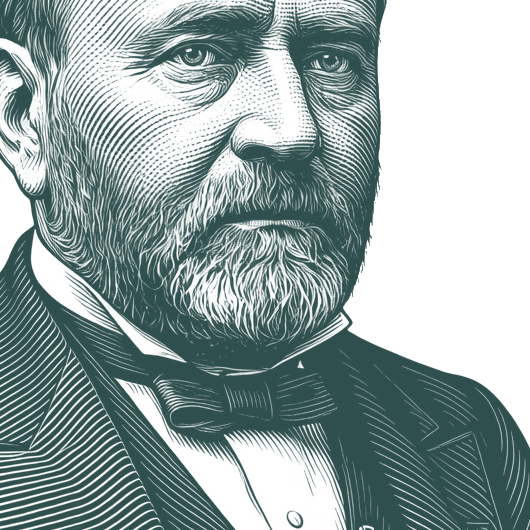
Ulysses S. Grant (27 April 1822 – 23 July 1885), born as Hiram Ulysses Grant, was the 18th president of the United States of America, from 1869 to 1877. As the Commanding General of the U.S. Army, Grant worked closely with U.S. President Abraham Lincoln to lead the U.S. Army to victory over the Confederacy in the American Civil War. He implemented Congressional Reconstruction, often at odds with Lincoln's successor, Andrew Johnson. Twice elected to the presidency, Grant led the Republicans in their effort to remove the vestiges of Confederate nationalism and slavery, protect the citizenship of African-Americans, and support U.S. economic prosperity.
Biography information from
Wikiquote·
Portrait adapted from
Wikimedia Commons, Brady-Handy Photograph Collection, Library of Congress (Public domain / CC0)
Also Known As
Birth Name:
Hiram Ulysses Grant
Also Known As:“Unconditional Surrender” Grant
Alternative Names:
General Grant
•
Ulysses Hiram Grant
•
Ulysses Grant
•
Ulysses S Grant
•
President Grant
•
U. S. Grant
•
U.S. Grant
•
Ulysses Simpson Grant
I leave comparisons to history, claiming only that I have acted in every instance from a conscientious desire to do what was right, constitutional, within the law, and for the very best interests of the whole people. Failures have been errors of judgment, not of intent.
"In my first interview with Mr. Lincoln alone he stated to me that he had never professed to be a military man or to know how campaigns should be conducted, and never wanted to interfere in them: but that procrastination on the part of commanders, and the pressure from the people at the North and Congress, WHICH WAS ALWAYS WITH HIM, forced him into issuing his series of “Military Orders" — one, two, three, etc. He did not know but they were all wrong, and did know that some of them were. All he wanted or had ever wanted was some one who would take the responsibility and act, and call on him for all the assistance needed, pledging himself to use all the power of the government in rendering such assistance. Assuring him that I would do the best I could with the means at hand, and avoid as far as possible annoying him or the War Department, our first interview ended.
Unlimited Quote Collections
Organize your favorite quotes without limits. Create themed collections for every occasion with Premium.