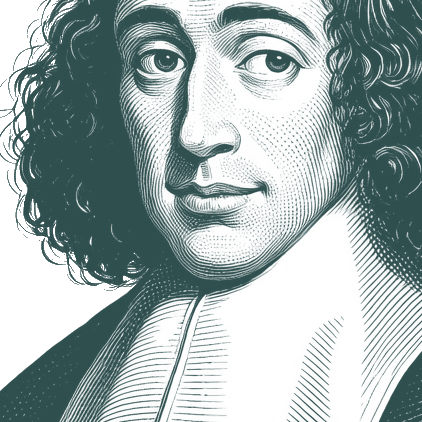
MÉTODO (methodus) Dada la existencia de una fuerza innata o potencia de pensar (TIE 31 y 37) capaz de generar ideas adecuadas, el método consiste en … - Benedictus de Spinoza
""
MÉTODO (methodus) Dada la existencia de una fuerza innata o potencia de pensar (TIE 31 y 37) capaz de generar ideas adecuadas, el método consiste en guiarla y ejercerla para conseguir un razonamiento genético (explicación por la causa) riguroso. De ahí el uso del célebre estilo «geométrico»: definiciones y axiomas se trenzan para mostrar su coherencia y permitir la cadena deductiva de las demostraciones, lo que supone que esas afirmaciones pasen de meramente «nominales» a ser «reales» y den cuenta de la naturaleza de las cosas.
Benedictus de Spinoza (24 November 1632 – 21 February 1677) was a social and metaphysical philosopher known for the elaborate development of his monist philosophy, which has become known as Spinozism. Controversy regarding his ideas led to his excommunication from the Jewish community of his native Amsterdam. He was named Baruch ("blessed" in Hebrew) Spinoza by his synagogue elders and known as Bento de Spinoza or Bento d'Espiñoza, but afterwards used the name Benedictus ("blessed" in Latin) de Spinoza.
Native Name:
בָּרוּךְ שְׂפִּינוֹזָה
•
Benedito de Espinosa
Alternative Names:
Benedict de Spinoza
•
Baruch de Espinosa
•
Barukh Shpinozah
•
Benoît de Spinoza
•
Sbīnūzā
•
Ispīnūzā
•
Barukh Spinoza
•
Bento de Espinosa
•
Baruch d' Espinoza
•
Shpinozah
•
Baruch de Spinoza
•
Spinoza
•
Benoit de Spinoza
•
Benedictus De Spinoza
•
Benedictus Spinoza
•
Baruch Spinoza
•
Baruch Benedictus de Spinoza
I now want, much more briefly, to take another path across my essays in order to look at another group of theses developed there on the question of "knowledge". I cannot hide the fact that in this matter I depended heavily on Spinoza. I said a moment ago that Marx was close to Hegel in his critique of the idea of a theory of knowledge. But this Hegelian critique is already present in Spinoza. What does Spinoza in fact mean when he writes, in a famous phrase, "Habemus enim ideam veram..."? That we have a true idea? No: the weight of the phrase lies on the "enim". It is in fact because and only because we have a true idea that we can produce others, according to its norm. And it is in fact because and only because we have a true idea that we can know that it is true, because it is "index sui". Where does this true idea come from? That is quite a different question. But it is a fact that we do have it (habemus), and whatever it may be that produces this result, it governs everything that can be said about it and derived from it. Thus Spinoza in advance makes every theory of knowledge, which reasons about the justification of knowledge, dependent on the fact of the knowledge which we already possess. And so every question of the Origin, Subject and Justification of knowledge, which lie at the root of all theories of knowledge, is rejected. But that does not prevent Spinoza from talking about knowledge: not in order to understand its Origin, Subject and Justification, but in order to determine the process and its moments, the famous "three levels", which moreover appear very strange when you look at them close up, because the first is properly the lived world, and the last is specially suited to grasping the "singular essence" -- or what Hegel would in his language call the "universal concrete" -- of the Jewish people, which is heretically treated in the Theologico-Political Treatise. I am sorry if some people consider, apparently out of theoretical opportunism, that I thus fall into a heresy, but I would say that Marx -- not only the Marx of the 1857 Introduction, which in fact opposes Hegel through Spinoza, but the Marx of Capital, together with Lenin -- is in fact on close terms with Spinoza's positions.
[We] will discuss Soul and Body, the doctrine of God, and Ethics. ...We shall find that Leibniz no longer shows great originality, but tends, with slight alterations of phraseology, to adopt (without acknowledgment) the views of the decried Spinoza. We shall find also many more minor inconsistencies than in the earlier part of [Leibniz's] system, these being due chiefly to the desire to avoid the impieties of the Jewish Atheist, and the still greater impieties to which Leibniz's own logic should have led him.
PREMIUM FEATURE
Advanced Search Filters
Filter search results by source, date, and more with our premium search tools.