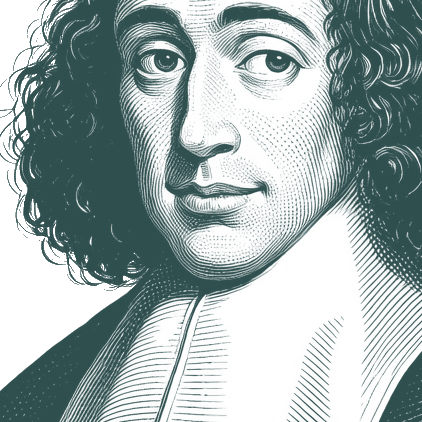
Benedictus de Spinoza (24 November 1632 – 21 February 1677) was a social and metaphysical philosopher known for the elaborate development of his monist philosophy, which has become known as Spinozism. Controversy regarding his ideas led to his excommunication from the Jewish community of his native Amsterdam. He was named Baruch ("blessed" in Hebrew) Spinoza by his synagogue elders and known as Bento de Spinoza or Bento d'Espiñoza, but afterwards used the name Benedictus ("blessed" in Latin) de Spinoza.
Native Name:
בָּרוּךְ שְׂפִּינוֹזָה
•
Benedito de Espinosa
Alternative Names:
Benedict de Spinoza
•
Baruch de Espinosa
•
Barukh Shpinozah
•
Benoît de Spinoza
•
Sbīnūzā
•
Ispīnūzā
•
Barukh Spinoza
•
Bento de Espinosa
•
Baruch d' Espinoza
•
Shpinozah
•
Baruch de Spinoza
•
Spinoza
•
Benoit de Spinoza
•
Benedictus De Spinoza
•
Benedictus Spinoza
•
Baruch Spinoza
•
Baruch Benedictus de Spinoza
What Spinoza regards as ‘true religion’ and ‘true piety’ requires no belief in any historical events, supernatural incidents or metaphysical doctrines, and it prescribes no devotional rites. It does not demand accepting any particular theology of God's nature or philosophical claims about the cosmos and its origins. The divine law directs us only on how to behave with justice and charity toward other human beings. ‘[We are] to uphold justice, help the helpless, do no murder, covet no man's goods, and so on’. All the other rituals or ceremonies of the Bible's commandments are empty practices that ‘do not contribute to blessedness and virtue’. True religion is nothing more than moral behaviour. It is not what you believe, but what you do that matters. Writing to the Englishman and secretary to the Royal Society Henry Oldenburg in 1675, Spinoza says that ‘the chief distinction I make between religion and superstition is that the latter is founded on ignorance, the former on wisdom’.
Some have spoken of a liberal Spinoza, and others, of a democratic Spinoza. By the same standard one could also speak of an artistocratic Spinoza or a monarchical Spinoza — and it has been done. Perhaps also an anarchic Spinoza? No one has ever said that.
Try QuoteGPT
Chat naturally about what you need. Each answer links back to real quotes with citations.
What can be said is that Spinoza is, without question, one of history's most eloquent proponents of a secular, democratic society and the strongest advocate for freedom and toleration in the early modern period.