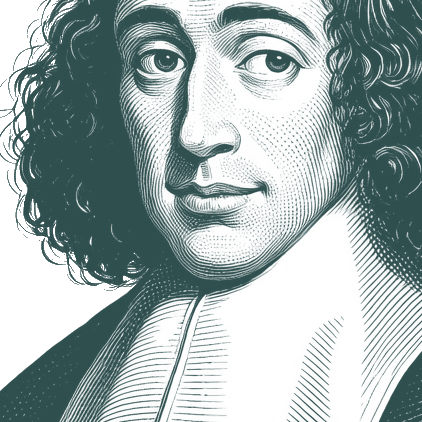
Benedictus de Spinoza (24 November 1632 – 21 February 1677) was a social and metaphysical philosopher known for the elaborate development of his monist philosophy, which has become known as Spinozism. Controversy regarding his ideas led to his excommunication from the Jewish community of his native Amsterdam. He was named Baruch ("blessed" in Hebrew) Spinoza by his synagogue elders and known as Bento de Spinoza or Bento d'Espiñoza, but afterwards used the name Benedictus ("blessed" in Latin) de Spinoza.
Native Name:
בָּרוּךְ שְׂפִּינוֹזָה
•
Benedito de Espinosa
Alternative Names:
Benedict de Spinoza
•
Baruch de Espinosa
•
Barukh Shpinozah
•
Benoît de Spinoza
•
Sbīnūzā
•
Ispīnūzā
•
Barukh Spinoza
•
Bento de Espinosa
•
Baruch d' Espinoza
•
Shpinozah
•
Baruch de Spinoza
•
Spinoza
•
Benoit de Spinoza
•
Benedictus De Spinoza
•
Benedictus Spinoza
•
Baruch Spinoza
•
Baruch Benedictus de Spinoza
Better that right counsels be known to enemies than that the evil secrets of tyrants should be concealed from the citizens. They who can treat secretly of the affairs of a nation have it absolutely under their authority; and as they plot against the enemy in time of war, so do they against the citizens in time of peace.
Spinoza was a republican democrat and a supporter of the politician Johan De Witt (1625–72), an opponent of the House of Orange. After De Witt's death, the aristocratic Orange faction took power and restored a more conventional social order (which was subsequently imposed on Britain when one of them acquired the English throne in 1689). By that time ‘Spinozism’ was already a thriving underground cult with ardent supporters in many countries: ‘The battle was on to fix the image of the dying Spinoza in the perceptions and imagination of posterity,’ Israel writes, since ‘the final hours of a thinker who seeks to transform the spiritual foundations of the society around him become heavily charged with symbolic significance in the eyes of both disciples and adversaries.’ Plainly, this battle still continues. It is not to disregard or minimise such a striking lineage to observe that Spinozism had limitations associated with the society it came from, in which countries were struggling to emerge from absolutism and theocratic tyranny. Today, Spinoza's greatness has to be defended against the delusions of a belated progeny, rather as Marx had to be in the later 19th and 20th centuries.
Jorge Luis Borges, "Baruch Spinoza", in his Selected Poems, edited by Alexander Coleman. (New York: Penguin Books, 2000)