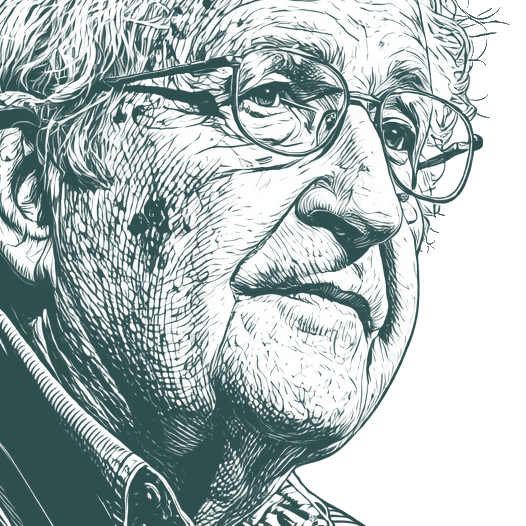
There is a growing realization that it is an illusion to believe that all will be well if only today’s liberal hero can be placed in the White House,… - Noam Chomsky
""
There is a growing realization that it is an illusion to believe that all will be well if only today’s liberal hero can be placed in the White House, and a growing awareness that isolated, competing individuals can rarely confront repressive institutions alone. At best, a few may be tolerated as intellectual gadflies. The mass, even under formal democracy, will accept “the values that have been inculcated, often accidentally and often deliberately by vested interests,” values that have the status of “unconsciously acquired habits rather than choices.” In a fragmented, competitive society, individuals can neither discover their true interests nor act to defend them, as they cannot do so when prevented from free association by totalitarian controls. Recognition of these facts has brought young men together in various forms of resistance and has given rise to the little-known but very impressive attempts at community organizing in many parts of the country […]
Avram Noam Chomsky (born 7 December 1928) is an American linguist, analytical philosopher, cognitive scientist, political analyst, human rights activist and anarcho-socialist.
Biography information from
Wikiquote·
Portrait adapted from
Wikimedia Commons, Augusto Starita / Ministerio de Cultura de la Nación (CC BY-SA)
We might add now that we do have an authoritative account of why the United States bombed Serbia in 1999. It comes from Strobe Talbott, now the director of the Brookings Institution, but in 1999 he was in charge of the State Department-Pentagon team that supervised the diplomacy in the affair. He wrote the introduction to a recent book by his Director of Communications, John Norris, which presents the position of the Clinton administration at the time of the bombing. Norris writes that "it was Yugoslavia's resistance to the broader trends of political and economic reform - not the plight of Kosovar Albanians - that best explains NATO's war". In brief, they were resisting absorption into the U.S. dominated international socioeconomic system. Talbott adds that thanks to John Norris, anyone interested in the war in Kosovo "will know … how events looked and felt at the time to those of us who were involved" in the war, actually directing it. This authoritative explanation will come as no surprise at all to students of international affairs who are more interested in fact than rhetoric. And it will also come as no surprise, to those familiar with intellectual life, that the attack continues to be hailed as a grand achievement of humanitarian intervention, despite massive Western documentation to the contrary, and now an explicit denial at the highest level; which will change nothing, it's not the way intellectual life works.
We need not stride resolutely towards catastrophe, merely because those are the marching orders.
Works in ChatGPT, Claude, or Any AI
Add semantic quote search to your AI assistant via MCP. One command setup.
When we lament over the German conscience, we are demanding of them a display of self-hatred -- a good thing, no doubt. But for us the matter is infinitely more serious. It is not a matter of self-hatred regarding the sins of the past. Like the German Kaiser, we believe that everything must be put to fire and sword, so that the war will be more quickly finished -- and we act on this belief. Unlike the German Kaiser, our soul is not torn.