"Everything that ever happened to him in his life," she said, "all the things we said and did. Where did it go?" I didn't have an answer, so I just d… - Louise Erdrich
"Everything that ever happened to him in his life," she said, "all the things we said and did. Where did it go?" I didn't have an answer, so I just drove. Once I had caused a miracle by smashing my face on ice, but now I was an ordinary person. In the few miles we had left I could not help drawing out [her] strange idea in my mind. In my line of work I've seen thousands of brains that belonged to sheep, pork, steers. They were all gray lumps like ours. Where did everything go? What was really inside? The flat fields unfolded, the shallow ditches ran beside the road. I felt the live thoughts hum inside of me, and I pictured tiny bees, insects made of blue electricity, in a colony so fragile that it would scatter at the slightest touch. I imagined a blow, like a mallet to the sheep, or a stroke, and I saw the whole swarm vibrating out. Who could stop them? Who could catch them in their hands? (p203-4)
Louise Erdrich (born Karen Louise Erdrich June 7, 1964) is an American author, novelist, poet, and children's author who features Native American themes in her writings. She is an enrolled member of the Turtle Mountain Band of Chippewa Indians, a federally recognized tribe of Ojibwe people.
Biography information from
Wikiquote·
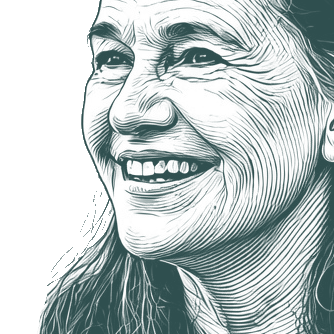
Portrait adapted from
Wikimedia Commons, Alessio Jacona from Rome, Italy (CC BY-SA)
The only answer to this, and it isn't an entire answer, said Father Travis, is that God made human beings free agents. We are able to choose good over evil, but the opposite too. And in order to protect our human freedom, God doesn't often, very often at least, intervene. God can't do that without taking away our moral freedom. Do you see?
No. But yeah.
The only thing that God can do, and does all of the time, is to draw good from any evil situation.
Try QuoteGPT
Chat naturally about what you need. Each answer links back to real quotes with citations.
It is difficult for a woman to admit that she gets along with her own mother — somehow it seems a form of betrayal, at least, it used to among other women in my generation. To join the company of women, to be adults, we go through a period of proudly boasting of having survived our own mother's indifference, anger, overpowering love, the burden of her pain, her tendency to drink or teetotal, her warmth or coldness, praise or criticism, sexual confusions or embarrassing clarity. It isn't enough that she sweat, labored, bore her daughters howling or under total anesthesia or both. No. She must be responsible for our psychic weaknesses the rest of her life. It is alright to feel kinship with your father, to forgive. We all know that. But your mother is held to a standard so exacting that it has no principles. She simply must be to blame. (p20)