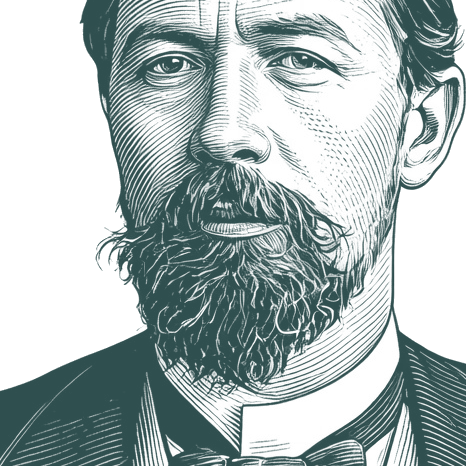
We are accustomed to live in hopes of good weather, a good harvest, a nice love-affair, hopes of becoming rich or getting the office of chief of poli… - Anton Chekhov
""
We are accustomed to live in hopes of good weather, a good harvest, a nice love-affair, hopes of becoming rich or getting the office of chief of police, but I've never noticed anyone hoping to get wiser. We say to ourselves: it'll be better under a new tsar, and in two hundred years it'll still be better, and nobody tries to make this good time come tomorrow. On the whole, life gets more and more complex every day and moves on its own sweet will, and people get more and more stupid, and get isolated from life in ever-increasing numbers.
English
Collect this quote
About
Anton Chekhov
Anton Pavlovich Chekhov (Анто́н Па́влович Че́хов) (29 January 1860 – 15 July 1904) (Old Style: 17 January 1860 – 2 July 1904) was a Russian short story writer and playwright.
Three months later Olenka was coming home from mass, melancholy and in deep mourning. It happened that one of her neighbours, Vassily Andreitch Pustovalov, returning home from church, walked back beside her. He was the manager at Babakayev's, the timber merchant's. He wore a straw hat, a white waistcoat, and a gold watch-chain, and looked more a country gentleman than a man in trade. "Everything happens as it is ordained, Olga Semyonovna," he said gravely, with a sympathetic note in his voice; "and if any of our dear ones die, it must be because it is the will of God, so we ought have fortitude and bear it submissively." ... All day afterwards she heard his sedately dignified voice, and whenever she shut her eyes she saw his dark beard. She liked him very much. And apparently she had made an impression on him too, for not long afterwards an elderly lady, with whom she was only slightly acquainted, came to drink coffee with her, and as soon as she was seated at table began to talk about Pustovalov, saying that he was an excellent man whom one could thoroughly depend upon, and that any girl would be glad to marry him. Three days later Pustovalov came himself. He did not stay long, only about ten minutes, and he did not say much, but when he left, Olenka loved him--loved him so much that she lay awake all night in a perfect fever, and in the morning she sent for the elderly lady. The match was quickly arranged, and then came the wedding.
Probably nature itself gave man the ability to lie so that in difficult and tense moments he could protect his nest, just as do the vixen and wild duck.
I divide all literary works into two categories: Those I like and those I don’t like. No other criterion exists for me.