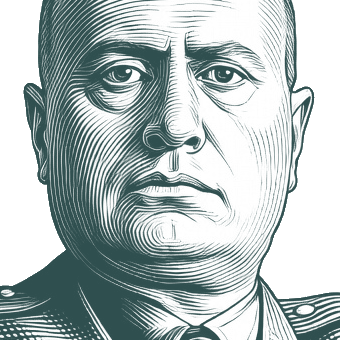
The shout of your legitimate exultation merges with the shout rising from all the cities of Spain now wholly free from the Reds’ infamy, and with the… - Benito Mussolini
""
The shout of your legitimate exultation merges with the shout rising from all the cities of Spain now wholly free from the Reds’ infamy, and with the shout of the anti-Bolsheviks from all over the world. The bright victory of Barcelona is another chapter in the history of the new Europe we are creating. Franco’s magnificent troops and our intrepid legionnaires did not defeat only Negrín’s government. Many others among our enemies are biting the dust right now. The Reds’ watchword was ‘No pasarán’, but we passed and, I am telling you, we will pass.
Benito Amilcare Andrea Mussolini (29 July 1883 – 28 April 1945) was an Italian politician and journalist who founded and led the National Fascist Party. He was Prime Minister of Italy from the March on Rome in 1922 until his deposition in 1943, and "Duce" of Italian Fascism from the establishment of the Italian Fasces of Combat in 1919 until his execution in 1945 by Italian partisans. As dictator of Italy and principal founder of fascism, Mussolini inspired and supported the international spread of fascist movements during the inter-war period.
Fascism entirely agrees with Mr. Maynard Keynes, despite the latter's prominent position as a Liberal. In fact, Mr. Keynes' excellent little book, The End of Laissez-Faire (1926) might, so far as it goes, serve as a useful introduction to fascist economics. There is scarcely anything to object to in it and there is much to applaud.
Here in Italy Socialism was a unifying factor. All Italian historians have recognized this. The Socialists of Italy were advocates of one idea and of one nation. From 1892, when they cut adrift from the anarchists at the Congress of Genoa, down till 1911, they battled for on behalf of a united Italy.”
The country is young, but its institutions are old; and when — If I may be allowed to quote once more from Karl Marx, the old Pangermanist — a conflict between new forces and old institutions begins to shape itself, that means that the new wine cannot any longer be kept in the old skins, or the inevitable will occur. The old forces of the political and social life of Italy will fall into fragments.