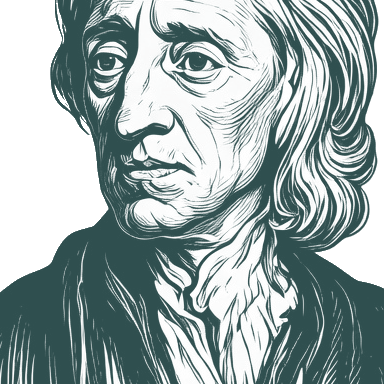
Men being, as has been said, by nature, all free, equal and independent, no one can be put out of this estate, and subjected to the political power o… - John Locke
""
Men being, as has been said, by nature, all free, equal and independent, no one can be put out of this estate, and subjected to the political power of another, without his own consent.
John Locke (29 August 1632 – 28 October 1704) was an influential English philosopher and social contract theorist. He developed an alternative to the Hobbesian state of nature and asserted a government could be good only if it received the consent of the governed and protected the natural rights of life, liberty, and estate. If such a consent was not achieved, Locke argued in favour of a right of rebellion, which he referred to as an "appeal to heaven".
Biography information from
Wikiquote·
Portrait adapted from
Wikimedia Commons, Godfrey Kneller (Public domain / CC0)
This I think is sufficiently evident, that children generally hate to be idle. All the care then is, that their busy humour should be constantly employ'd in something of use to them; which, if you will attain, you must make what you would have them do a recreation to them, and not a business.
The toleration of those that differ from others in matters of religion is so agreeable to the Gospel of Jesus Christ, and to the genuine reason of mankind, that it seems monstrous for men to be so blind as not to perceive the necessity and advantage of it in so clear a light. I will not here tax the pride and ambition of some, the passion and uncharitable zeal of others. These are faults from which human affairs can perhaps scarce ever be perfectly freed; but yet such as nobody will bear the plain imputation of, without covering them with some specious colour; and so pretend to commendation, whilst they are carried away by their own irregular passions. But, however, that some may not colour their spirit of persecution and unchristian cruelty with a pretence of care of the public weal and observation of the laws; and that others, under pretence of religion, may not seek impunity for their libertinism and licentiousness; in a word, that none may impose either upon himself or others, by the pretences of loyalty and obedience to the prince, or of tenderness and sincerity in the worship of God; I esteem it above all things necessary to distinguish exactly the business of civil government from that of religion and to settle the just bounds that lie between the one and the other. If this be not done, there can be no end put to the controversies that will be always arising between those that have, or at least pretend to have, on the one side, a concernment for the interest of men's souls, and, on the other side, a care of the commonwealth.
PREMIUM FEATURE
Advanced Search Filters
Filter search results by source, date, and more with our premium search tools.
The law of faith, being a covenant of free grace, God alone can appoint what shall be necessarily believed by everyone whom He will justify. What is the faith which He will accept and account for righteousness, depends wholly on his good pleasure. For it is of grace, and not of right, that this faith is accepted. And therefore He alone can set the measures of it: and what he has so appointed and declared is alone necessary. No-body can add to these fundamental articles of faith; nor make any other necessary, but what God himself hath made, and declared to be so. And what these are which God requires of those who will enter into, and receive the benefits of the new covenant, has already been shown. An explicit belief of these is absolutely required of all those to whom the gospel of Jesus Christ is preached, and salvation through his name proposed.