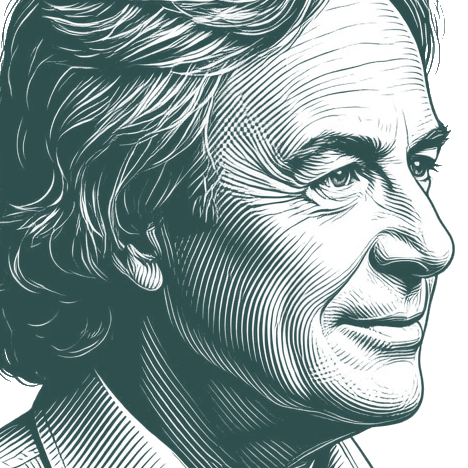
The other great heritage is Christian ethics — the basis of action on love, the brotherhood of all men, the value of the individual, the humility of … - Richard Feynman
""
The other great heritage is Christian ethics — the basis of action on love, the brotherhood of all men, the value of the individual, the humility of the spirit. These two heritages are logically, thoroughly consistent.
English
Collect this quote
About
Richard Feynman
Richard Phillips Feynman (May 11, 1918 – February 15, 1988) was an American theoretical physicist. He is known for the work he did in the path integral formulation of quantum mechanics, the theory of quantum electrodynamics, the physics of the superfluidity of supercooled liquid helium, and in particle physics, for which he proposed the parton model. For his contributions to the development of quantum electrodynamics, Feynman received the Nobel Prize in Physics in 1965 jointly with Julian Schwinger and Shin'ichirō Tomonaga. Feynman developed a widely used pictorial representation scheme for the mathematical expressions describing the behavior of subatomic particles, which later became known as Feynman diagrams. During his lifetime, Feynman became one of the best-known scientists in the world.
Biography information from
Wikiquote·
Portrait adapted from
Wikimedia Commons, Copyright Tamiko Thiel 1984 (CC BY-SA)
Also Known As
Pen Names:
Ofey
Native Name:
Richard Phillips Feynman
Alternative Names:
Feynman
•
Dick Feynman
•
Richard P. Feynman
There are 10<sup>11</sup> stars in the galaxy. That used to be a huge number. But it's only a hundred billion. It's less than the national deficit! We used to call them astronomical numbers. Now we should call them economical numbers.
i have a friend who’s an artist and he’s sometimes taken a view which i don’t agree with very well. he’ll hold up a flower and say, “look how beautiful it is,” and i’ll agree, i think. and he says - “you see, i as an artist can see how beautiful this is, but you as a scientist, oh, take this all apart and it becomes a dull thing.” and i think that he’s kind of nutty. first of all, the beauty that he sees is available to other people and to me, too, i believe, although i might not be quite as refined aesthetically as he is; but i can appreciate the beauty of a flower. at the same time i see much more about the flower than he sees. i can imagine the cells in there, the complicated actions inside which also have a beauty. i mean it’s not just beauty at this dimension of one centimeter, there is also beauty at a smaller dimension, the inner structure. also the processes, the fact that the colors in the flower evolved in order to attract insects to pollinate it is interesting - it means that insects can see the color. it adds a question: does this aesthetic sense also exist in the lower forms? why is it aesthetic? all kinds of interesting questions which shows that a science knowledge only adds to the excitement and mystery and the awe of a flower. it only adds; i don’t understand how it subtracts..
Enhance Your Quote Experience
Enjoy ad-free browsing, unlimited collections, and advanced search features with Premium.