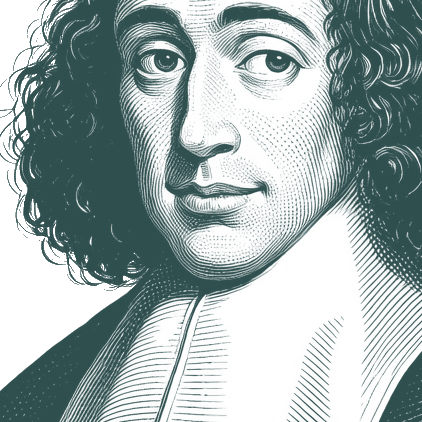
To Spinoza the Jew, it is declared two-hundred-fifty years after his death, from the heights of Mount Scopus, from our Temple-in-miniature (mikdash-h… - Benedictus de Spinoza
""
To Spinoza the Jew, it is declared two-hundred-fifty years after his death, from the heights of Mount Scopus, from our Temple-in-miniature (mikdash-ha-me'at)—the Hebrew University in Jerusalem: ...The herem (ban) is nullified! The sin of Judaism against you is removed and your offense against her atoned for! Our brother are you, our brother are you, our brother are you! (Ahinu ata, ahinu ata, ahinu ata!)
Benedictus de Spinoza (24 November 1632 – 21 February 1677) was a social and metaphysical philosopher known for the elaborate development of his monist philosophy, which has become known as Spinozism. Controversy regarding his ideas led to his excommunication from the Jewish community of his native Amsterdam. He was named Baruch ("blessed" in Hebrew) Spinoza by his synagogue elders and known as Bento de Spinoza or Bento d'Espiñoza, but afterwards used the name Benedictus ("blessed" in Latin) de Spinoza.
Native Name:
בָּרוּךְ שְׂפִּינוֹזָה
•
Benedito de Espinosa
Alternative Names:
Benedict de Spinoza
•
Baruch de Espinosa
•
Barukh Shpinozah
•
Benoît de Spinoza
•
Sbīnūzā
•
Ispīnūzā
•
Barukh Spinoza
•
Bento de Espinosa
•
Baruch d' Espinoza
•
Shpinozah
•
Baruch de Spinoza
•
Spinoza
•
Benoit de Spinoza
•
Benedictus De Spinoza
•
Benedictus Spinoza
•
Baruch Spinoza
•
Baruch Benedictus de Spinoza
...This awareness has become a kind of pre-Freudian self-analysis for me; Spinoza helps me to see myself and my surroundings objectively. This can make life bearable even throughout the experience of suffering; the teachings presented in the Ethics allow one to preceive the world as a manageable place. Freud himself once wrote in a letter to [Lothar] Bickel, 'I admit my dependence on Spinoza's teachings.' Conversely, Spinoza admits, foreshadowing Freudian analysis, that we cannot be in complete control over our emotions. [...] The ability to create emotional balance, though, is dependent upon the intellectual awareness of the problem. In this way Spinoza demands the integration of all human aspects in order to attain true freedom.
Deus est omnium rerum causa immanens, non vero transiens
Works in ChatGPT, Claude, or Any AI
Add semantic quote search to your AI assistant via MCP. One command setup.
LIBERTAD Y NECESIDAD (libertas-necessitas) La libertad es la afirmación de la necesidad de una naturaleza particular, esto es, de su ser; por eso se habla de la «libre necesidad» (Ep 58), sea en la forma plena e incondicionada de lo absoluto o en la mucho más restringida de los seres finitos, donde hay determinación entre ellos que coacciona (E1Def7). Ser libre, en cualquier caso, es hacer valer la propia esencia-potencia frente a otras, en el marco de las relaciones causales que a todos conciernen,