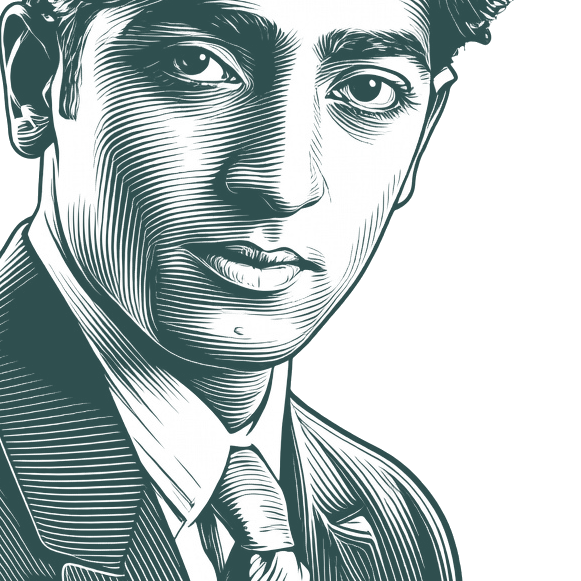
Jiddu Krishnamurti (11 May 1895 – 17 February 1986) was a spiritual teacher, public speaker, and writer, on psychological, sociological, and spiritual subjects.
In this constant battle which we call living, we try to set a code of conduct according to the society in which we are brought up, whether it be a Communist society or a so-called free society; we accept a standard of behaviour as part of our tradition as Hindus or Muslims or Christians or whatever we happen to be. We look to someone to tell us what is right or wrong behaviour, what is right or wrong thought, and in following this pattern our conduct and our thinking become mechanical, our responses automatic. We can observe this very easily in ourselves.
Attention involves seeing and hearing. We hear not only with our ears but also we are sensitive to the tones, the voice, to the implication of words, to hear without interference, to capture instantly the depth of a sound. Sound plays an extraordinary part in our lives: the sound of thunder, a flute playing in the distance, the unheard sound of the universe; the sound of silence, the sound of one’s own heart beating; the sound of a bird and the noise of a man walking on the pavement; the waterfall. The universe is filled with sound. This sound has its own silence; all living things are involved in this sound of silence. To be attentive is to hear this silence and move with it.
Limited Time Offer
Premium members can get their quote collection automatically imported into their Quotewise collections.
I think there is a difference between the human being and the individual. The individual is a local entity, living in a particular country, belonging to a particular culture, particular society, particular religion. The human being is not a local entity. He is everywhere. If the individual merely acts in a particular corner of the vast field of life, then his action is totally unrelated to the whole. So one has to bear in mind that we are talking of the whole not the part, because in the greater the lesser is, but in the lesser the greater is not. The individual is the little conditioned, miserable, frustrated entity, satisfied with his little gods and his little traditions, whereas a human being is concerned with the total welfare, the total misery and total confusion of the world.