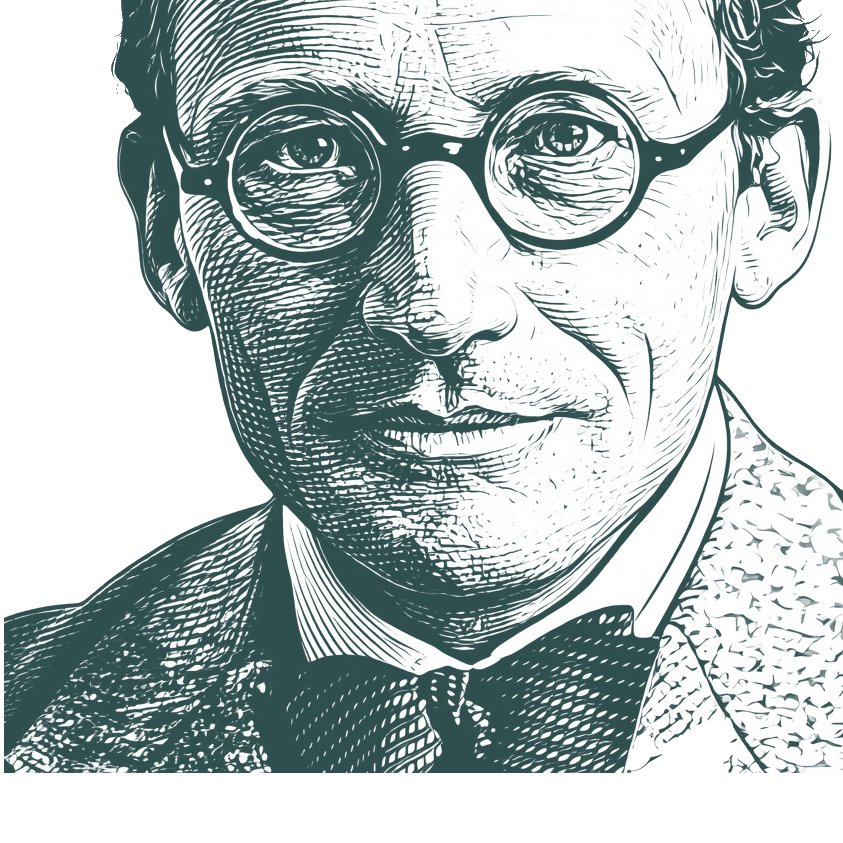
Erwin Rudolf Josef Alexander Schrödinger (12 August 1887 – 4 January 1961) was an Austrian physicist, one of the founders of quantum theory, and winner of the 1933 Nobel Prize in Physics. His ideas were heavily influenced by monist philosophy and he is particularly well known for original interpretations of the significance of the wave function and for devising the Schrödinger's cat thought experiment.
Alternative Names:
Erwin Rudolf Josef Alexander Schröndinger
•
Erwin Schrodinger
•
Erwin Schroedinger
•
Schrödinger
•
Schrodinger
•
Ervinus Rudolphus Iosephus Alexandrus Schrödinger
The spread, both in and width and depth, of the multifarious branches of knowledge by during the last hundred odd years has confronted us with a queer dilemma. We feel clearly that we are only now beginning to acquire reliable material for welding together the sum total of all that is known into a whole; but, on the other hand, it has become next to impossible for a single mind fully to command more than a small specialized portion of it. I can see no other escape from this dilemma (lest our true who aim be lost for ever) than that some of us should venture to embark on a synthesis of facts and theories, albeit with second-hand and incomplete knowledge of some of them -and at the risk of making fools of ourselves.
From Delbrück’s general picture of the hereditary substance it emerges that living matter, while not eluding the ‘laws of physics’ as established up to date, is likely to involve ‘other laws of physics’ hitherto unknown, which, however, once they have been revealed, will form just as integral a part of this science as the former.
Go Premium
Support Quotewise while enjoying an ad-free experience and premium features.
But the term code-script is, of course, too narrow. The chromosome structures are at the same time instrumental in bringing about the development they foreshadow.