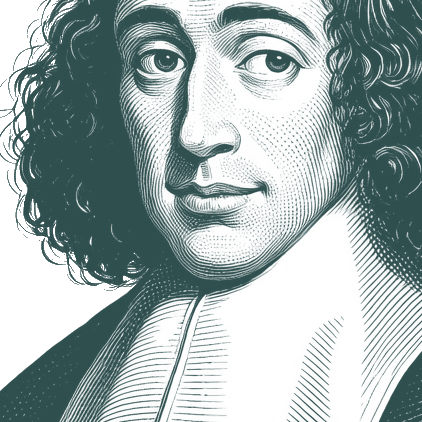
Benedictus de Spinoza (24 November 1632 – 21 February 1677) was a social and metaphysical philosopher known for the elaborate development of his monist philosophy, which has become known as Spinozism. Controversy regarding his ideas led to his excommunication from the Jewish community of his native Amsterdam. He was named Baruch ("blessed" in Hebrew) Spinoza by his synagogue elders and known as Bento de Spinoza or Bento d'Espiñoza, but afterwards used the name Benedictus ("blessed" in Latin) de Spinoza.
Native Name:
בָּרוּךְ שְׂפִּינוֹזָה
•
Benedito de Espinosa
Alternative Names:
Benedict de Spinoza
•
Baruch de Espinosa
•
Barukh Shpinozah
•
Benoît de Spinoza
•
Sbīnūzā
•
Ispīnūzā
•
Barukh Spinoza
•
Bento de Espinosa
•
Baruch d' Espinoza
•
Shpinozah
•
Baruch de Spinoza
•
Spinoza
•
Benoit de Spinoza
•
Benedictus De Spinoza
•
Benedictus Spinoza
•
Baruch Spinoza
•
Baruch Benedictus de Spinoza
Of Bruno, as of Spinoza, it may be said that he was "God-intoxicated." He felt that the Divine Excellence had its abode in the very heart of Nature and within his own body and spirit. Indwelling in every dewdrop as in the innumerable host of heaven, in the humblest flower and in the mind of man, he found the living spirit of God, setting forth the Divine glory, making the Divine perfection and inspiring with the Divine love.
In 1663 Spinoza published the only work to which he ever set his name... He had prepared a summary of the second part of Descartes' 'Principles of Philosophy' for the use of a pupil... Certain of Spinoza's friends became curious about this manual and desired him to treat the first part of Descartes' work also in the same manner. This was done within a fortnight and Spinoza was then urged to publish the book, which he readily agreed to do upon condition that one of his friends would revise the language and write a preface explaining that the author did not agree with all the Cartesian doctrine... The contents... [included] an appendix of 'Metaphysical Reflections,' professedly written from a Cartesian point of view, but often giving significant hints of the author's real divergence from Descartes. ...'On this opportunity,' he writes to Oldenburg, 'we may find some persons holding the highest places in my country... who will be anxious to see those other writings which I acknowledge for my own, and will therefore take such order that I can give them to the world without danger of any inconvenience. If it so happens, I doubt not that I shall soon publish something; if not, I will rather hold my peace than thrust my opinions upon men against the will of my country and make enemies of them.' ...The book on Descartes excited considerable attention and interest, but the untoward course of public events in succeeding years was unfavourable to a liberal policy, and deprived Spinoza of the support for which he had looked. ... If Spinoza had ever been a disciple of Descartes, he had completely ceased to be so... He did not suppose the geometrical form of statement and argument to be an infallible method of arriving at philosophical truth; for in this work he made use of it to set forth opinions with which he himself did not agree, and proofs with which he was not satisfied. We do not know to what extent Spinoza's manual was accepted or taken into use by Cartesians, but its accuracy as an exposition of Descartes is beyond question. One of the many perverse criticisms made on Spinoza by modern writers is that he did not understand the fundamental proposition cogito ergo sum. In fact he gives precisely the same explanation of it that is given by Descartes himself in the Meditations.
Go Premium
Support Quotewise while enjoying an ad-free experience and premium features.
Because of the specific epistemological interests of English philosophy and the dominance of Cartesianism in French thought, Spinoza's philosophical influence was centered in Germany. Of the great German figures Gotthold Ephraim Lessing was the first to come under the spell of Spinoza. He was a man of broad vision, with a hundred cultural interests and a critical disposition of mind, and would not accept any philosophical system in its totality. While he did not accept Spinozism in its entirety, he subscribed to its pantheistic doctrines. But more than he admired Spinoza's philosophy, he was attracted to him by his great earnestness of purpose, his strength of character, and his moral courage.