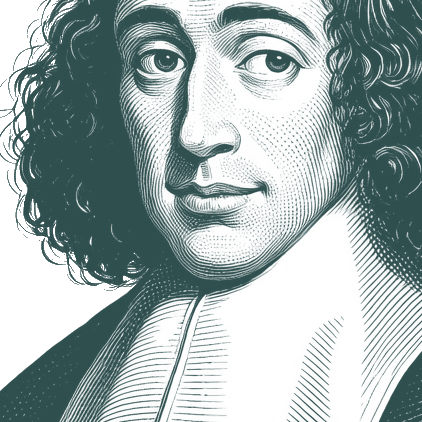
There is no place in Spinoza's system for a sense of mystery in the face of nature. Such an attitude is to be dispelled by the intelligibility of thi… - Benedictus de Spinoza
""
There is no place in Spinoza's system for a sense of mystery in the face of nature. Such an attitude is to be dispelled by the intelligibility of things. Religious wonder is bred by ignorance, he believes. Spinoza contrasts the person who "is eager, like an educated man, to understand natural things" with the person who "wonders at them, like a fool". For Spinoza, anyone who would approach nature with the kind of worshipful awe usually demanded by the religious attitude represents the latter. By definition, and in substance, pantheism is not atheism. And Spinoza is an atheist.
English
Collect this quote
About
Benedictus de Spinoza
Benedictus de Spinoza (24 November 1632 – 21 February 1677) was a social and metaphysical philosopher known for the elaborate development of his monist philosophy, which has become known as Spinozism. Controversy regarding his ideas led to his excommunication from the Jewish community of his native Amsterdam. He was named Baruch ("blessed" in Hebrew) Spinoza by his synagogue elders and known as Bento de Spinoza or Bento d'Espiñoza, but afterwards used the name Benedictus ("blessed" in Latin) de Spinoza.
Native Name:
בָּרוּךְ שְׂפִּינוֹזָה
•
Benedito de Espinosa
Alternative Names:
Benedict de Spinoza
•
Baruch de Espinosa
•
Barukh Shpinozah
•
Benoît de Spinoza
•
Sbīnūzā
•
Ispīnūzā
•
Barukh Spinoza
•
Bento de Espinosa
•
Baruch d' Espinoza
•
Shpinozah
•
Baruch de Spinoza
•
Spinoza
•
Benoit de Spinoza
•
Benedictus De Spinoza
•
Benedictus Spinoza
•
Baruch Spinoza
•
Baruch Benedictus de Spinoza
Here we come to the main point of the German Philosophy of Identity, which in essence differs in no way from the doctrine of Spinoza. No matter how violently Mr. Schelling may protest that his philosophy is different from Spinozism, that it is rather "a living amalgam of the ideal and the real," that it differs from Spinozism "as the perfection of Greek sculpture differs from the rigid Egyptian originals," nevertheless I must declare most emphatically that in his earlier period, when he was still a philosopher, Mr. Schelling did not differ in the slightest from Spinoza. He merely arrived at the same philosophy by a different path. I shall illustrate this later when I tell how Kant entered on a new path, how Fichte followed him, how Mr. Schelling in turn continued in Fichte's footsteps and, wandering lost in the forest darkness of nature philosophy, finally found himself face to face with the great figure of Spinoza. The only merit of modern nature philosophy is that it demonstrated most ingeniously the eternal parallelism between spirit and matter. I say spirit and matter, and I use these terms as equivalents for what Spinoza calls thought and dimension. These terms are also, to some extent, synonymous with what our nature philosophers call spirit and nature or the ideal and the real. In what follows I shall designate by the name Pantheism not so much Spinoza's system as his way of viewing things. Pantheism, like Deism, assumes the unity of God. But the god of the pantheist is in the world itself, not by permeating it with his divinity in the manner which St. Augustine tried to illustrate by comparing God to a large lake and the world to a large sponge lying in the middle of it and absorbing the Deity—no, the world is not merely God‑imbued, God‑impregnated; it is identical with God. "God," called by Spinoza the one and only substance, and by German philosophers the absolute, "is everything that exists"; He is matter as well as spirit, both are equally divine, and whoever insults the sanctity of matter is just as sinful as he who sins against the Holy Ghost.
There is no substitute for knowledge, self-knowledge, or a metaphysical understanding of the score and one's relationship to it; and no amount of talent or even training can compensate for the lack of all these elements. 'Man thinks,' says Spinoza, and this thinking is the result of a dialogue between the intellect, the emotions and the intuition. This is not only true of the thinking of each individual, but of groups of people and even of nations.
Works in ChatGPT, Claude, or Any AI
Add semantic quote search to your AI assistant via MCP. One command setup.