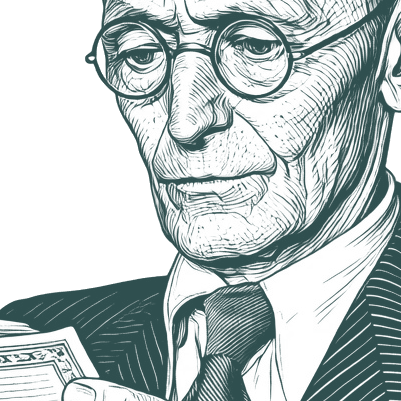
Each man's life represents a road toward himself, an attempt at such a road, the intimation of a path. No man has ever been entirely and completely h… - Hermann Hesse
""
Each man's life represents a road toward himself, an attempt at such a road, the intimation of a path. No man has ever been entirely and completely himself.
Hermann Karl Hesse (2 July 1877 – 9 August 1962) was a German-Swiss poet, novelist, and painter. In 1946, he received the Nobel Prize in Literature. His most famous works include Steppenwolf, Siddhartha, and The Glass Bead Game (also known as Magister Ludi) all of which explore an individual's search for spirituality.
There was once a man, Harry, called the steppenwolf. He went on two legs, wore clothes and was a human being, but nevertheless he was in reality a wolf of the steppes. He had learned a good deal of all that people of a good intelligence can, and was a fairly clever fellow. What he had not learned, however, was this: to find contentment in himself and his own life.
The world was so beautiful when regarded like this, without searching, so simply, in such a childlike way. Moons and stas were beautiful, beautiful were bank and stream, forest and rocks, goat and gold-bug, flower and butterfly. So lovely, so delightful to go through the world this way, so like a child, awake, open to what is near, without distrust.
PREMIUM FEATURE
Advanced Search Filters
Filter search results by source, date, and more with our premium search tools.
Our mind is capable of passing beyond the dividing line we have drawn for it. Beyond the pairs of opposites of which the world consists, other, new insights begin.