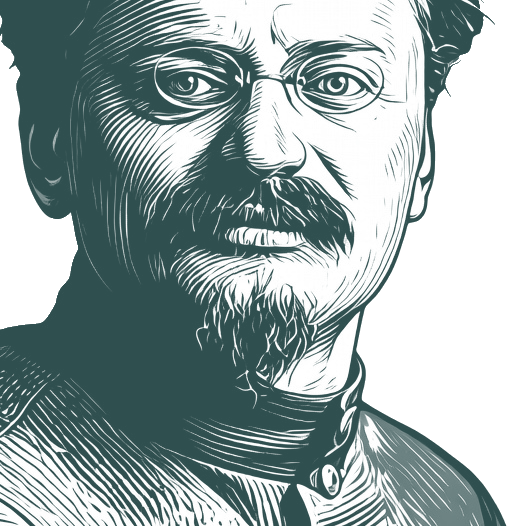
In case of actual danger, the social democracy banks not on the "Iron Front" but on the Prussian police. It is reckoning without its host! The fact t… - Leon Trotsky
""
In case of actual danger, the social democracy banks not on the "Iron Front" but on the Prussian police. It is reckoning without its host! The fact that the police was originally recruited in large numbers from among social-democratic workers is absolutely meaningless. Consciousness is determined by environment even in this instance. The worker who becomes a policeman in the service of the capitalist state, is a bourgeois cop, not a worker. Of late years, these policemen have had to do much more fighting with revolutionary workers than with Nazi students. Such training does not fail to leave its effects. And above all: every policeman knows that though governments may change, the police remains.
English
Collect this quote
About
Leon Trotsky
Leon Trotsky (Лев Давидович Троцкий; born Lev Davidovich Bronstein; Лев Давидович Бронштейн]; 7 November (O.S. 26 October) 1879 – 21 August 1940) was a Russian Marxist, intellectual, and revolutionary. In the early Soviet Union, he founded the Politburo, served as People's Commissar for Foreign Affairs, and created and led the Red Army. After Lenin's death, Trotsky was exiled for his opposition to Joseph Stalin's policies. His 1940 assassination (with an ice axe) in Mexico was carried out by a Soviet agent (Ramón Mercader) at Stalin's behest.
Pen Names:
Троцкий
•
Перо
•
Антид Ото
•
Л. Седов
•
Старик
Native Name:
Лейба Давидович Бронштейн
•
Лев Давидович Троцкий
Alternative Names:
Lev Bronstein
•
Lev Davidovich Bronshtein
•
Lev Davidovich Bronstein
•
Leon Trotski
•
Trotsky
•
Lev Davidovich Bronshteyn
•
Lev Bronshteyn
•
Lev Trotsky
•
Trotskiy
•
Lev Trotskiy
•
Lev Davidovich Trotsky
•
Lev Davidovich Trotskiy
The end may justify the means as long as there is something that justifies the end.
I know well enough, from my own experience, the historical ebb and flow. They are governed by their own laws. Mere impatience will not expedite their change. I have grown accustomed to viewing the historical perspective not from the stand point of my personal fate. To understand the causal sequence of events and to find somewhere in the sequence one's own place – that is the first duty of a revolutionary. And at the same time, it is the greatest personal satisfaction possible for a man who does not limit his tasks to the present day.
PREMIUM FEATURE
Advanced Search Filters
Filter search results by source, date, and more with our premium search tools.
We seek to uncover behind the events changes in the collective consciousness. We reject wholesale references to the “spontaneity” of the movement, references which in most cases explain nothing and teach nobody. Revolutions take place according to certain laws. This does not mean that the masses in action are aware of the laws of revolution, but it does mean that the changes in mass consciousness are not accidental, but are subject to an objective necessity which is capable of theoretic explanation, and thus makes both prophecy and leadership possible.