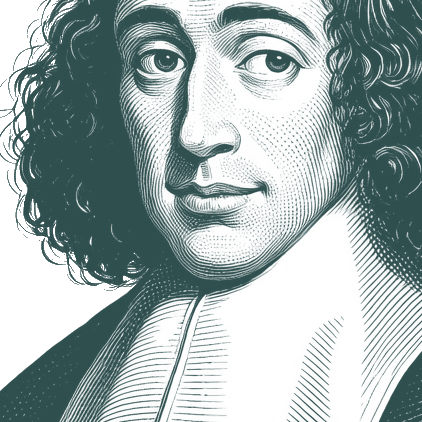
Benedictus de Spinoza (24 November 1632 – 21 February 1677) was a social and metaphysical philosopher known for the elaborate development of his monist philosophy, which has become known as Spinozism. Controversy regarding his ideas led to his excommunication from the Jewish community of his native Amsterdam. He was named Baruch ("blessed" in Hebrew) Spinoza by his synagogue elders and known as Bento de Spinoza or Bento d'Espiñoza, but afterwards used the name Benedictus ("blessed" in Latin) de Spinoza.
Native Name:
בָּרוּךְ שְׂפִּינוֹזָה
•
Benedito de Espinosa
Alternative Names:
Benedict de Spinoza
•
Baruch de Espinosa
•
Barukh Shpinozah
•
Benoît de Spinoza
•
Sbīnūzā
•
Ispīnūzā
•
Barukh Spinoza
•
Bento de Espinosa
•
Baruch d' Espinoza
•
Shpinozah
•
Baruch de Spinoza
•
Spinoza
•
Benoit de Spinoza
•
Benedictus De Spinoza
•
Benedictus Spinoza
•
Baruch Spinoza
•
Baruch Benedictus de Spinoza
Most writers on the emotions and on human conduct seem to be treating rather of matters outside nature than of natural phenomena following nature's general laws. They appear to conceive man to be situated in nature as a kingdom within a kingdom: for they believe that he disturbs rather than follows nature's order, that he has absolute control over his actions, and that he is determined solely by himself. They attribute human infirmities and fickleness, not to the power of nature in general, but to some mysterious flaw in the nature of man, which accordingly they bemoan, deride, despise, or, as usually happens, abuse: he, who succeeds in hitting off the weakness of the human mind more eloquently or more acutely than his fellows, is looked upon as a seer. [...] Such persons will, doubtless think it strange that I should attempt to treat of human vice and folly geometrically, and should wish to set forth with rigid reasoning those matters which they cry out against as repugnant to reason, frivolous, absurd, and dreadful. However, such is my plan.
Of all the great modern philosophers, Spinoza is probably the most interesting in relation to human life, and is certainly the most lovable and high-minded. Unfortunately, the difficulty and crabbedness of his writing make it very hard for people who are not serious students of philosophy to understand even what is not inherently difficult in his doctrines. He therefore requires commentaries to translate him into easier language, if his main ideas are to be appreciated as widely as possible. [...] Spinoza's philosophy, however, whether we agree with it or not, remains one of the noblest monuments of human genius, and whoever makes it more widely accessible is doing a useful work. To readers unacquainted with philosophy, Mr. Picton's book may therefore be confidently recommended.
Man can, indeed, act contrarily to the decrees of God, as far as they have been written like laws in the minds of ourselves or the prophets, but against that eternal decree of God, which is written in universal nature, and has regard to the course of nature as a whole, he can do nothing.