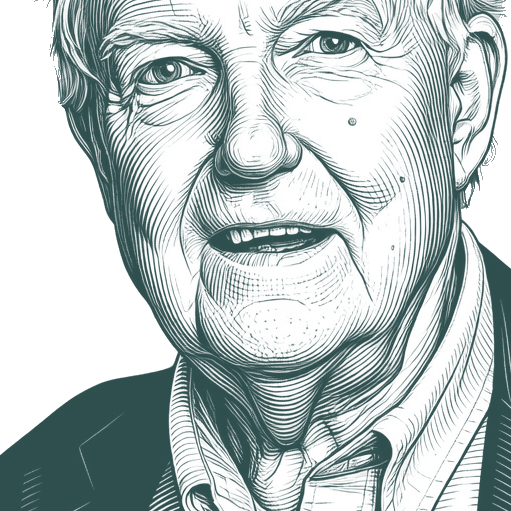
Disraeli never took the defensive line that Jews were no worse than other men. He thought they were better. He said he despised ‘that pernicious doct… - Paul Johnson
""
Disraeli never took the defensive line that Jews were no worse than other men. He thought they were better. He said he despised ‘that pernicious doctrine of modern times, the natural equality of man’. One modern historian has seen him as essentially a marrano, and there is a lot to be said for this analysis.40 He epitomized the incipient arrogance, pride and romance of the Sephardis, which he conferred on the Jews as a whole. The self-destructive Ashkenazi tendency to see Jewish sufferings in Biblical fashion as the merited consequence of Jewish sins meant absolutely nothing to him. He took the Sephardi view that Israel, being the heart of the human body, had been unfairly made to shoulder the burden of the wickedness of mankind.
English
Collect this quote
About
Paul Johnson
Paul Bede Johnson (2 November 1928 – 12 January 2023) was an English journalist, historian, speechwriter and author.
Biography information from
Wikiquote·
Portrait adapted from
Wikimedia Commons, Alan Davidson (Public domain / CC0)
Yiddish was particularly good at borrowing: from Arabic, from Hebrew-Aramaic, from anything which came its way. On the other hand it contributed: to Hebrew, to English-American. Its chief virtue, however, lay in its internal subtlety, particularly in its characterization of human types and emotions.62 It was the language of street wisdom, of the clever underdog; of pathos, resignation, suffering, which it palliated by humour, intense irony and superstition. Isaac Bashevis Singer, its greatest practitioner, pointed out that it is the only language never spoken by men in power.
Twain had it too and Alexander Woollcott. Stephen Spender and Barbara Skelton insisted Cyril Connolly had it, on rare occasions, when the word for it was “magnificent,” but I only heard faint echoes of this gigantic gift. Sir Isaiah Berlin had it, and I heard him: but the trouble was, once he got really going on a line of fantastic humor, he began to speak so fast, and his accent became so impenetrable, that the sense wasdifficult to grasp, though his evident delight in his fun was so furious that you laughed all the same.
Works in ChatGPT, Claude, or Any AI
Add semantic quote search to your AI assistant via MCP. One command setup.
If Paul brought the first generation of Christians the useful skills of a trained theologian, Origen was the first great philosopher to rethink the new religion from first principles. As his philosophical enemy, the anti-Christian Porphyry, summed it up, he 'introduced Greek ideas to foreign fables' — that is, gave a barbarous eastern religion the intellectual respectability of a philosophical defense. Origen was also a phenomenon. As Eusebius put it admiringly, 'even the facts from his cradle are worth mentioning'. Origen came from Alexandria, the second city of the empire and then it's intellectual centre; his father's martyrdom left him an orphan at seventeen with six younger brothers. He was a hard working prodigy, at eighteen head of the Catechetical School, and already trained as a literary scholar and teacher. But at this point, probably in 203, he became a religious fanatic and remained one for the next fifty years. He gave up his job and sold his books to concentrate on religion. he slept on the floor, ate no meat, drank no wine, had only one coat and no shoes. He almost certainly castrated himself, in obedience to the notorious text, Matthew 19:12, 'there are some who have made themselves eunuchs for the kingdom of heaven's sake.' Origen's learning was massive and it was of a highly original kind: he always went back to the sources and thought through the whole process himself. This he learned Hebrew and, according to Eusebius, 'got into his possession the original writings extant among the Jews in the actual Hebrew character'. These included the discovery of lost texts; in the case of the psalms, Origen collected not only the four known texts but three others unearthed, including 'one he found at Jericho in a jar'. The result was an enormous tome, the Hexapla, which probably existed in only one manuscript now lost, setting out the seven alternative texts in parallel columns. He applied the same principles of original research to every aspect of Chr