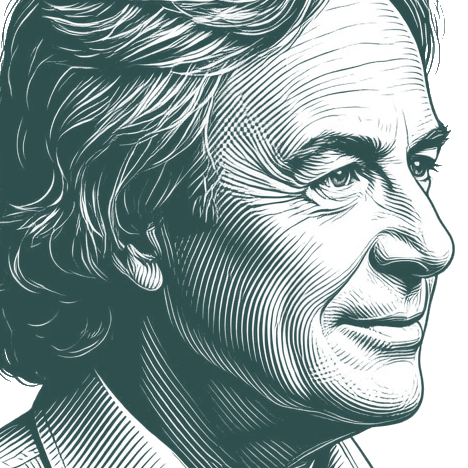
"What is this "zero mass"? The masses given here are the masses of the
particles at rest. The fact that a particle has zero mass means, in a way, tha… - Richard Feynman
"What is this "zero mass"? The masses given here are the masses of the particles at rest. The fact that a particle has zero mass means, in a way, that it cannot be at rest. A photon is never at rest, it is always moving at 186,000 miles a second."
Richard Phillips Feynman (May 11, 1918 – February 15, 1988) was an American theoretical physicist. He is known for the work he did in the path integral formulation of quantum mechanics, the theory of quantum electrodynamics, the physics of the superfluidity of supercooled liquid helium, and in particle physics, for which he proposed the parton model. For his contributions to the development of quantum electrodynamics, Feynman received the Nobel Prize in Physics in 1965 jointly with Julian Schwinger and Shin'ichirō Tomonaga. Feynman developed a widely used pictorial representation scheme for the mathematical expressions describing the behavior of subatomic particles, which later became known as Feynman diagrams. During his lifetime, Feynman became one of the best-known scientists in the world.
Biography information from
Wikiquote·
Portrait adapted from
Wikimedia Commons, Copyright Tamiko Thiel 1984 (CC BY-SA)
Also Known As
Pen Names:
Ofey
Native Name:
Richard Phillips Feynman
Alternative Names:
Feynman
•
Dick Feynman
•
Richard P. Feynman
I’m talking about a specific, extra type of integrity that is not lying, but bending over backwards to show how you’re maybe wrong, that you ought to have when acting as a scientist.
I have to understand the world, you see.
There is nothing that living things do that cannot be understood from the point of view that they are made of atoms acting according to the laws of physics.