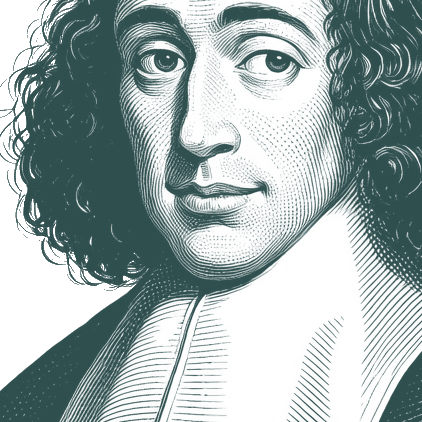
[The] right of the individual is co-extensive with its determinate power. ...
Nature's bounds are not set by the laws of human reason which aim only … - Benedictus de Spinoza
""
[The] right of the individual is co-extensive with its determinate power. ... Nature's bounds are not set by the laws of human reason which aim only at man's true interest and his preservation ... man is but a particle.
Benedictus de Spinoza (24 November 1632 – 21 February 1677) was a social and metaphysical philosopher known for the elaborate development of his monist philosophy, which has become known as Spinozism. Controversy regarding his ideas led to his excommunication from the Jewish community of his native Amsterdam. He was named Baruch ("blessed" in Hebrew) Spinoza by his synagogue elders and known as Bento de Spinoza or Bento d'Espiñoza, but afterwards used the name Benedictus ("blessed" in Latin) de Spinoza.
Native Name:
בָּרוּךְ שְׂפִּינוֹזָה
•
Benedito de Espinosa
Alternative Names:
Benedict de Spinoza
•
Baruch de Espinosa
•
Barukh Shpinozah
•
Benoît de Spinoza
•
Sbīnūzā
•
Ispīnūzā
•
Barukh Spinoza
•
Bento de Espinosa
•
Baruch d' Espinoza
•
Shpinozah
•
Baruch de Spinoza
•
Spinoza
•
Benoit de Spinoza
•
Benedictus De Spinoza
•
Benedictus Spinoza
•
Baruch Spinoza
•
Baruch Benedictus de Spinoza
...The teaching of Spinoza, the product of the Jewish genius and modern science [Wissenschaft], does not stand in contradiction with the Jewish teaching of unity - at most it may contradict its rationalistic and super-naturalistic approach.
...[I]t was the Goethe problem. He [Alfred Rosenberg] worshipped Goethe. And Goethe worshipped Spinoza. Alfred could not rid himself of this cursed book because Goethe loved it enough to carry it in his pocket for an entire year. This obscure Jewish nonsense had calmed Goethe's unruly passions and made him see the world more clearly than ever before. How could that be? Goethe saw something in it that he could not discern.
Works in ChatGPT, Claude, or Any AI
Add semantic quote search to your AI assistant via MCP. One command setup.
The superstitious know how to reproach people for their vices better than they know how to teach them virtues, and they strive, not to guide men by reason, but to restrain them by fear, so that they flee the evil rather than love virtues. Such people aim only to make others as wretched as they themselves are, so it is no wonder that they are generally burdensome and hateful to men.