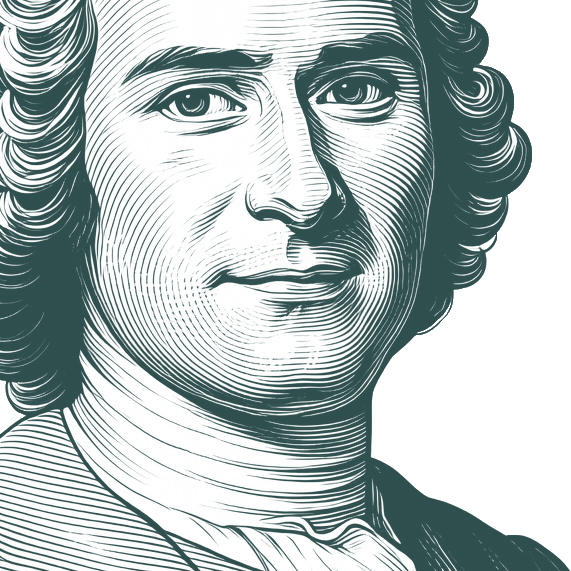
Jean-Jacques Rousseau (June 28, 1712 – July 2, 1778) was a major French-speaking Genevan philosopher of Enlightenment whose political ideas influenced the French Revolution, the development of socialist theory, and the growth of nationalism.
Biography information from
Wikiquote·
Portrait adapted from
Wikimedia Commons, Maurice Quentin de La Tour (Public domain / CC0)
Also Known As
Alternative Names:
Citizen of Geneva
•
Jean Jacques Rousseau
•
J. J. Rousseau
•
Rousseau
•
J.J. Rousseau
•
JJ Rousseau
If there is a state where the soul can find a resting-place secure enough to establish itself and concentrate its entire being there, with no need to remember the past or reach into the future, where time is nothing to it, where the present runs on indefinitely but this duration goes unnoticed, with no sign of the passing of time, and no other feeling of deprivation or enjoyment, pleasure or pain, desire or fear than the simple feeling of existence, a feeling that fills our soul entirely, as long as this state lasts, we can call ourselves happy, not with a poor, incomplete and relative happiness such as we find in the pleasures of life, but with a sufficient, complete and perfect happiness which leaves no emptiness to be filled in the soul.
Compadecemos la suerte de la infancia, mientras debiéramos llorar sobre la nuestra. Nuestros más graves males vienen de nosotros.
Works in ChatGPT, Claude, or Any AI
Add semantic quote search to your AI assistant via MCP. One command setup.
The new-born infant cries, his early days are spent in crying. He is alternately petted and shaken by way of soothing him; sometimes he is threatened, sometimes beaten, to keep him quiet. We do what he wants or we make him do what we want, we submit to his whims or subject him to our own. There is no middle course; he must rule or obey. Thus his earliest ideas are those of the tyrant or the slave. He commands before he can speak, he obeys before he can act, and sometimes he is punished for faults before he is aware of them, or rather before they are committed. Thus early are the seeds of evil passions sown in his young heart. At a later day these are attributed to nature, and when we have taken pains to make him bad we lament his badness. In this way the child passes six or seven years in the hands of women, the victim of his own caprices or theirs, and after they have taught him all sorts of things, when they have burdened his memory with words he cannot understand, or things which are of no use to him, when nature has been stifled by the passions they have implanted in him, this sham article is sent to a tutor. The tutor completes the development of the germs of artificiality which he finds already well grown, he teaches him everything except self-knowledge and self-control, the arts of life and happiness. When at length this infant slave and tyrant, crammed with knowledge but empty of sense, feeble alike in mind and body, is flung upon the world, and his helplessness, his pride, and his other vices are displayed, we begin to lament the wretchedness and perversity of mankind. We are wrong; this is the creature of our fantasy; the natural man is cast in another mould.